Please visit Search Engine Land for the full article.


from Search Engine Land: News & Info About SEO, PPC, SEM, Search Engines & Search Marketing https://ift.tt/2NLcJ9h
via


In early 2020, video overtook blogs and infographics as the most used type of marketing content. Around the same time, remote work grew more than ever before.
As companies quickly began to pivot to remote workspaces, video marketers were left wondering how they would create content with the same production level as something filmed in a brightly lit studio with professional equipment. Additionally, video creators who once filmed interviews or explainers featuring thought leaders needed to determine how they'd continue to incorporate talent remotely.
Despite the challenges of making videos from home, companies like HubSpot ultimately figured out processes that allowed them to keep creating helpful content for their audiences.
If you're a video manager working remotely for the first time, you might still be learning how to navigate and produce effective content on a timeline.
To help inspire new video strategies, I spoke to HubSpot's Academy and social media teams to get tips on how they implemented and created new remote production processes.
As you would with any content marketing campaign, consider topics that will educate, entertain, and delight your audiences -- even when they're clearly filmed in an at-home setting.
To come up with video ideas, schedule a virtual brainstorm with your team. Consider your brand's goals, messaging, and problems you can solve for your audience with informative content. Then narrow down a list of topics based on their level of value and how feasibly they can be made from a remote location.
For examples of marketing videos you can easily make from home -- even on a limited budget -- check out this blog post.
Any great content marketing strategy begins with a production plan. This was especially true for our HubSpot Academy team, which regularly films and publishes video content from our physical offices.
"We put together our plan shortly after the HubSpot offices went remote," says Stephen Fiske, HubSpot Academy's video producer. "We've typically always filmed in our studio, but knew that wouldn't be an option for the foreseeable future. So we had to pivot quickly, and come up with a solution that allowed us to continue creating content for our customers and prospects."
To make a solid remote video plan, go over your current production process and determine which aspects you can make virtual, such as editing, filming yourself, or adding animation. Then, talk with your team to determine workarounds for the things you're most used to filming in-person, such as studio interviews.
For example, the HubSpot Academy team had to ask questions like, "How will we film the thought leaders or Academy professors?" or "Are there ways we can support our talent remotely?" After answering these questions, the team came up with a strategy that enables their professors and thought leaders to film themselves.
With HubSpot Academy's process, Fiske says, "We've been able to continue creating content efficiently while meeting our high-quality standards."
"We know how important our education is for customers and prospects around the world, so we created this process for them," Fiske adds.
Around the same time, HubSpot's social media team also worked together to create a plan for their fully remote video strategy.
"For me, most of the pre-production process hasn’t changed much. There is certainly less in-person face-to-face interaction during ideation and pre-production but the process is still the same," says Thomas Hutchings, an associate editor and animator on the social team.
"One big change, as you can imagine, is video production itself," Hutchings admits. "From equipment to set space, I needed to dig deeper into my creative toolbox to come up with adequate workarounds that would still serve our customers and audience to the best of my ability given the circumstances."
While HubSpot Academy's new process primarily involved enabling talent to record themselves, Hutchings' involved everything from, "DIY rigs to rearranging my whole living space."
While Hutchings has done a lot to build out his home video production process, like Fiske, he notes that teamwork has been key to video production success.
"My manager and director have both been very helpful in making sure we have what we need, so I’m lucky to have their support," Hutchings adds.
When planning out remote video strategies, one of the major questions the Academy and social teams asked was, "What equipment are we able to use?"
"All on-camera presenters were sent a remote filming care package. Our video editors would do a "virtual location scout" of their homes to determine the best location to film in. They would also walk the presenters through how to set up the equipment," Fiske explains.
Similarly, Hutchings explains that the social media department was able to get him the equipment he needed.
But, if you work at a startup that can't ship equipment to you -- or even budget it in the first place -- that shouldn't stop you from making videos.
According to HubSpot's video managers, you can find a number of tools at home, or purchase them affordably online. Here's a quick list of things you'll need:
In a HubSpot YouTube video, featured below, Hutchings explains that a DSLR is the best camera to use for at-home videos, but an iPhone or other digital camera will also work.
When it came to HubSpot Academy, video creators and subjects were loaned an IPad Mini and an attachable wide-angle lens, which were both easy to use and enabled solid video recording.
"Lighting can make a video look almost professional, even when it’s shot on just a phone, but it’s all about the placement," says Lindsay Daly, a video editor and animator for the social team.
If you don't have traditional film lighting tools, you use light fixtures you have at home, such as lamps or natural light. However, the most important thing to keep in mind is the angle and positioning of the lights and camera.
"Your light source and camera lens should be pointed in the same direction on to your subject. Otherwise, that video recorded in front of your window is going to look more like an anonymous silhouette interview from a crime drama," Daly points out.
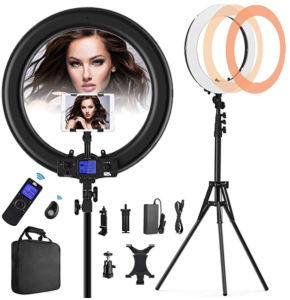
To avoid any video mishaps in apartments with poor natural light, HubSpot Academy also sent its video subjects a straightforward lighting ring with a stand. The stand holds the ring light as well as an IPad or phone to provide professional-looking lighting.
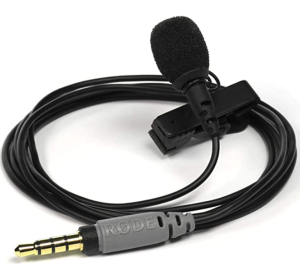
In Hutchings' how-to video, he also explains that you should film yourself in a quiet environment. If sound is coming through muffled on your camera or phone, you can also affordably purchase a microphone online. One mic to consider is a lavalier mic, which can clip to a subject's shirt. This type of mic was included in HubSpot Academy's remote video kits.
For tactical tips on creating your own home production studio, check out this video tutorial that Hutchings created for HubSpot's YouTube channel:
Despite how hard we try, many of our homes aren't aesthetically pleasing on camera. Even if we have a clean house, brand new furniture, and gorgeous curtains, our homes might have unexpected issues that make it very hard to film on camera. These issues could include distracting decor or poor lighting.
This is why HubSpot Academy made picking the right background a priority in their process. According to Fiske, each presenter that's filmed from home does a video test with the HubSpot Academy editor. As part of the test, the presenter walks around his or her apartment and sits in a few locations while on a video call with the editor.
After the talent or subject walks around their home, the editor gives feedback on which locations work best and lighting adjustments. This ensures that all videos the editor receive won't need to be re-shot due to background mishaps.
According to Fiske, a few great background options that you might find in your own home include bookcases, backgrounds with plants, and brick walls. You'll want to avoid sitting in front of windows without shades which can cause lighting issues, as well as plain white walls which can be dull, might also impact the white balance of your video.
If you don't have a video editor to help you pick out your own background, it can be a good idea to film yourself in different locations with different amounts of light. As you review each clip, ask yourself questions like, "Is my background distracting?", "Do I look like a dark shadow due to the lighting?", and "Do I look overexposed because of too much lighting?"
Aside from sending Academy presenters equipment and testing backgrounds with them, Fiske explains that editors and video managers would try to support their talent in other ways via video call.
For example, if a presenter needs assistance or feedback, Fiske says that "during filming, our video editors can join the shoots remotely, allowing them to direct the talent, and work with them to get the best lighting, framing, and audio."
Hutchings says his team has also taken steps to enable talent to film themselves for HubSpot's social channels. To him, one key to this process is using empathy whenever possible.
"I’ve had to direct videos via Zoom and troubleshoot situations for things I didn’t anticipate, like dogs barking in the background, construction noises, or poor cellphone camera angles." Hutchings shares. "One thing that keeps me on a positive note is empathy. I know that I’m not the only person going through this. I know that we are all in this together. So if a dog barks in the background and a viewer on YouTube notices it, maybe they can relate and appreciate the authenticity behind it."
"Many folks are going through challenges of filming remotely, and it’s not just the editors that have hurdles. It's also your talent," Hutchings says. "They have become more involved in the shooting process than before, which can add another level of complexity. Being patient and providing thoughtful practices goes a long way."
Every business is different and can vary when it comes to video production budgets and capabilities. Odds are, if another video manager or employee joins your team, they'll have some questions about how your brand creates videos scalably and remotely. This is why Hutchings and Fiske both made internal video production guides for their teams, talent, and other HubSpot employees.
"I created a short guide and an in-depth video to help our talent navigate the process of filming themselves and how to submit their footage," Hutchings explains. "This will save you time, so instead of repeating yourself to new talent you can send along a guide and get back to what you do best, creating. Also, in the future if remote work does in-fact become more prevalent, these guides will come in handy."
Meanwhile, Fiske created a detailed internal guide that highlights every step of HubSpot Academy's production process from start to finish. He then shared it with the wider company so employees outside of his department can reference and use it as needed.
While the HubSpot Academy and social media teams might have slightly different strategies, they've approached remote video with the same goal: create valuable content.
As you continue to build your remote video strategy and test out scalable marketing content, your production process will get smoother and you'll learn what videos truly engage your audience.
"No matter how fancy or basic your set-up is, content is still king," Hutchings concludes. "If you still forge great content that provides exceptional value to your customer and audience, viewers won’t mind some lighting issues or audio that’s of lower quality. Equipment is important, but there's a bit of wiggle room to be creative and find solutions that will still get the job done."
If these tips have inspired you to create a remote video production process, check out this post on three effective marketing videos you can make from home.

As marketers, we know the importance of making data-driven decisions.
The more data we know about our audience — from how many are being reached to how many engage with our content — the more we're able to make effective marketing moves.
Having the numbers to back up marketing strategy is almost as important as the strategy itself.
If numbers aren't your favorite thing to calculate, that's not a problem (thankfully). There are so many strategies and automation tools to back up those tough marketing choices effectively — no math needed.
For instance, let's say you're running a social media campaign, and one of your Facebook posts includes a video. You've never run a video ad, so you need data to prove it's the right move for engaging audiences.
To get that data, you decide to run a social test for engagement. In your test, one Facebook ad will show a short cut of the video and the other, a longer cut. If one of the videos reaches 50% of your benchmark engagement goal, you'll know the length is a good choice to capture the attention of users.
Social media tests, like the one explained above, let you run an experimental campaign before investing in the real thing. They show different versions of the same ad to the desired audience and allow you to pick the winning ad based on the campaign's objectives and what you know your audience wants to see. At the end of the social media test, you'll receive a report that provides the data breakdown of performance.
This strategy could be the answer to questions you have about your audience's behavior on social media. Sure, you can read industry standards and benchmarks as a jumping off point, but these tests are timely, accurate, and experiment for your specific audience.
Social media testing provides data-driven insight about your social media marketing activities. It allows you to analyze how different variables, like photo and video, affect performance. You might run a social media test, for example, to see if adding emojis to a post's caption increases engagement.
Ultimately, social media tests provide data about how audience behavior can influence the structure of your campaigns.
For example, you might run a social test to learn if video campaigns are worth investing in on Facebook. So, you create one that measures the impressions of an ad with and without a video attached. After the campaign, look at impressions to see if campaigns that have video are worth it for your brand.
Social media tests paint a picture of what messaging is successful for your brand. Instead of researching countless industry benchmarks about what works and what doesn't, you'll have the concrete data from testing.
There are three types of social media testing, and we'll discuss them next.
Let's say you want to know how copy affects an international audience on LinkedIn. Or, that you want evidence of a landing page performing better with a different image. Maybe you're trying to identify if changing the tone of Instagram captions will lead to more audience engagement.
All of these scenarios are prime for social tests. They point out a problem that can be answered with data. This data would give insight about audiences interactions with brands on social media.
After identifying the goal, it’s time to pick the type of test. Let's go through the different types and when you might use them.
A/B tests are likely the most common form of social testing. They look at a variable between two content types, measure the outlined goal, and provide results. Run an A/B test if you want to test a single, small variable that may alter audience behavior.
For example, if you want to test out different CTA buttons on a Facebook ad or experiment a post's copy with/without emojis, run an A/B test.
Split tests are often confused with A/B tests. In essence, they do the same thing: test two content types based on a goal. The difference is that a split test is more general than an A/B test; they're used to determine big changes, and the two variants are often completely different.
For example, use split testing if you want to know which layout of your Facebook Business page performs better. You can also run split tests to determine A/B test factors. For example, you can run a split test to determine which ad video cut you're going to use for a Sponsored Tweet, then A/B test different sections of the winning cut.
Multivariable tests work differently than the two previously mentioned types. They work with multiple variables instead of one or two. You can run a multivariable test to determine which of four ads works best. Alternatively, one can be run to assess the different makings of a post, like images vs. copy vs. captions.
Run a multivariate test if you want to see the results of more than two different elements. For example, compare the caption, image, and CTA of a LinkedIn post to see what audiences are responding to, or look at three versions of a GIF to learn how audiences react to them.
When you've picked out your social test experiment, make sure you're imploring best practices so the results are useful.
Social media testing can be extremely helpful — if you're executing correctly. Otherwise, your test could be inaccurate, immeasurable, and ultimately, a waste of time.
The good news is that social tests aren't hard to create or run. The bad news is that if you aren't prepared to run one, your results won't be usable. Make sure that when you make your test, you follow these best practices:
When your social test has one identifiable goal, everything else falls into place: variables, unit of measurement, and time frame. To illustrate this, let's say your goal is to improve international engagement with your next Facebook ad.
With that goal decided, you can create the variables, so you decide to run an A/B test to determine which copy earns the most impressions. You estimate that because your impression ads usually run for a month, half that time would give measurable results.
You also know the direction of the ad. When your goal is focused, you'll know what to look for during analysis. Impressions, for example, would be the metric to look at for the Facebook ad mentioned earlier.
If you decide to conduct a social test, results will reflect the behaviors of a specific target market. They can serve as a reference point of data about how certain customers engage with your messaging.
Social testing is a great way to learn about the social media behavior of an audience segment. If you had little to no information about how your millennial audience would react to a new Instagram Story Ad, running a test would give you a data-driven answer.
Without knowing your audience, your data wouldn't be applicable to a defined set of your target market. You'd have insight, but without a segmented audience, it's not clear how the results relate to your goal.
Before you run the test, know how your current campaign is running or make note of previous results. This is so, at the end of your experiment, you can compare results and make informed decisions. The previous report will give the background information and context needed to analyze the social test findings.
Even if your marketing goals for your social test are different than previous campaigns, it's still a good idea to refer to them for context. For instance, you may be testing for conversions rather than retargeting, but having an idea of what audiences prefer helps you structure your campaign.
Don't leave your test as soon as it begins — check on it so you can adjust things accordingly. A test that's running for a month, for example, should be checked regularly for performance benchmarks.
If you use social test software or tools on social media channels, the report starts aggregating when your test starts. When you check in, look at how you're tracking for your #1 goal. Additionally, take note of what other metrics you see, and how they're performing.
You might find, for instance, that your conversion rate is low. You can monitor conversions for the duration of the test, or make a small tweak to try to improve performance. For the next check-ins, you'll have an extra metric to take into account.
When the test concludes, you'll have the knowledge from previous checks to round out your perception of the completed report. Along with your intended goal, identify supporting metrics to understand how they work together.
How long should you run your test? Long enough to get the answer to your hypothesis. That doesn't tell you much, though, so let's add to that.
Ideally, your test should run for at least seven days. A week is enough time for your social testing software to compile a basis of data. It won't be as concrete as a longer test, but it's a starting point.
After seven days, look at your performance and decide if you've gathered enough data to answer your hypothesis. If not, run the test for a few more days. Based on the nature of your campaign, fix the time frame to fit your business and your audience — but make sure you give yourself enough room for an actionable report.
Picking a test duration period ensures you won't be wasting money and time. Instead of having a test run for too long or too little, figure out your time frame and budget during the planning process.
So, with these best practices in mind, you're almost ready to run a successful social test. Before you get going though, let's talk about where — and how — to do that.
There's a couple of avenues to explore when choosing where to run a social test. If you're running a test specifically for social media, the channel you're using might have testing tools in their business software.
Running social tests on the corresponding media platforms is helpful because you don't have to keep track of different channels during the test. Additionally, you won't have to worry about misconstrued data a third party might provide.
You can also run a social test using a CRM, like HubSpot. CRMs are a great choice if you want to test functions outside of social media — landing pages, emails, or other marketing activities. First, though, let's talk about social media offerings.
Facebook offers tools to run A/B and multivariate tests for ads. You can access these tests via Ad Manager. Ad Manager tells you which ads (or ad tests) are running and their status. When you click on a certain test, details and metrics open.
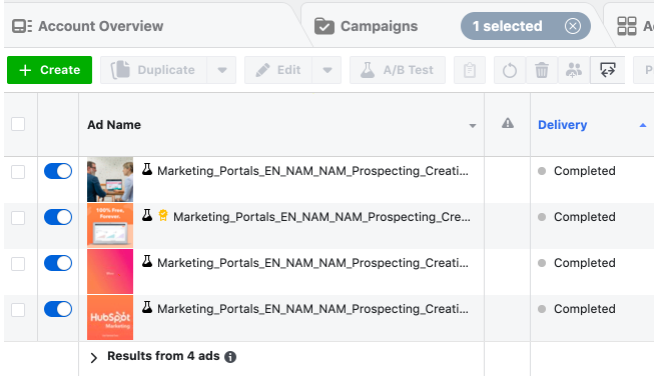
Multivariate tests on Facebook are similar, except they can be found in the Experiments section of your Facebook Business account. Though the social tests are located in different places, the process for setting them up is largely the same.
Social testing on Facebook is intuitive, especially if you're used to running Facebook Ads. After clicking "Create Ad," you'll be taken through a series of prompts to create, set metrics, and pick an audience. When you fill in the details, you publish it, and wait for the results.
Start small if you're getting the hang of things. Its features are customizable, so the choice is yours in terms of time frame, audience, copy, testing options, and metrics. As your familiarity grows, tests can be scaled.
As an example, after running a social test on Facebook, bone broth brand Kettle & Fire found a 14 point increase in brand awareness. The marketing team wanted to raise online sales with a video campaign, and wanted to find out which video length was favored by customers.
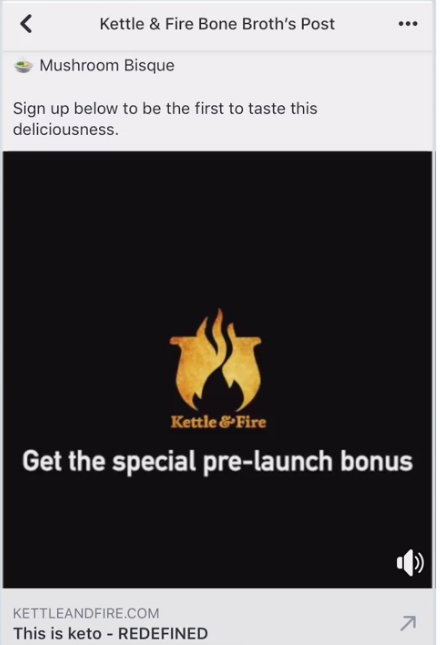
In a little less than a month, a 1.5 lift in purchasing consideration and sales conversions from the short video led to the answer. A Facebook test saved the team ad spend and informed them about their audience's Facebook preferences.
Facebook delivers social testing results in a downloadable report. The software determines the winner based on the metric(s) you chose when creating the test. For information about running a Facebook social testing, check out this post about testing on the platform.
Social testing on Twitter leads to creating tweets audiences will interact with and enjoy. You'll identify how they use the platform and know how to cater to their needs. Twitter's testing tools are best fit for creative, targeting, and brand awareness campaigns.
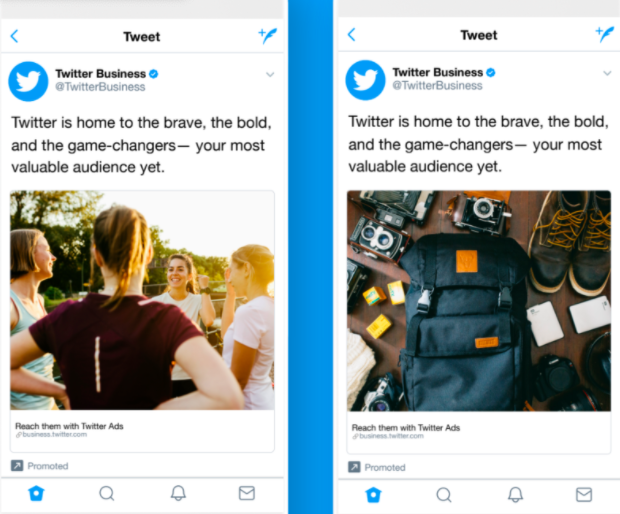
Twitter lets you social test Ads in an A/B format. To do this, after publishing the ad, go back into Ads, duplicate it, make the change, and publish the new variable. Track performance from the Tweet Activity Dashboard and campaign dashboard.
Note that there's no way to set an official test using Twitter, so you'll have to analyze the data yourself. For instance, if you want to see if your new brand voice is taking flight, you'll probably want to look at the amount of clicks and impressions your Ad earned.
If you're not used to LinkedIn Ads, there's several different types. They're sorted based on campaign goal, like Conversion, or type of ad, like Carousel, Text, or Sponsored. It's a great idea to test LinkedIn Ads for promoting — your brand, event, or job listing.
Dynamic Ads, which show up on the ride side of a user's main feed are highly personalized. Under Dynamic Ads, there's several versions: Follower, Job, Content, and Spotlight. These versions specify what the goal of your ad is — so if you want to let audiences know your company is hiring, you would run a Dynamic Job Ad.

If you wanted to make a similar Dynamic Job Ad on LinkedIn, you can run a test to see if your listing ad is compelling to job seekers. You'll have the option to test image layouts, such as the company photo, copy, and central images, if applicable.
LinkedIn's marketing team uses social testing for content and event promotion, as well as account-based marketing. They ran a test for a webinar Dynamic Ad to gauge if audiences preferred an image of the speaker or the company's logo. According to one of LinkedIn's senior marketing managers, Cassandra Clark, results included a 326% lift in click-through rate in the ad with the speaker.
To access ad results, check your Conversion Tracking dashboard, which will show you page and audience activity from your ads. While LinkedIn doesn't have a formal testing feature, they do have an option for you to duplicate and tweak a portion of an ad, like Twitter.
If you're not running a test on a social media channel, you can use software to help. If you use a CRM, you can set up tests for website content, like landing pages.
In HubSpot, you can run social tests for web pages simply by accessing your dashboard and going to one of your web pages. Click the "Actions" hyperlink next to one of your pages, and you'll find the option to "Run a test."
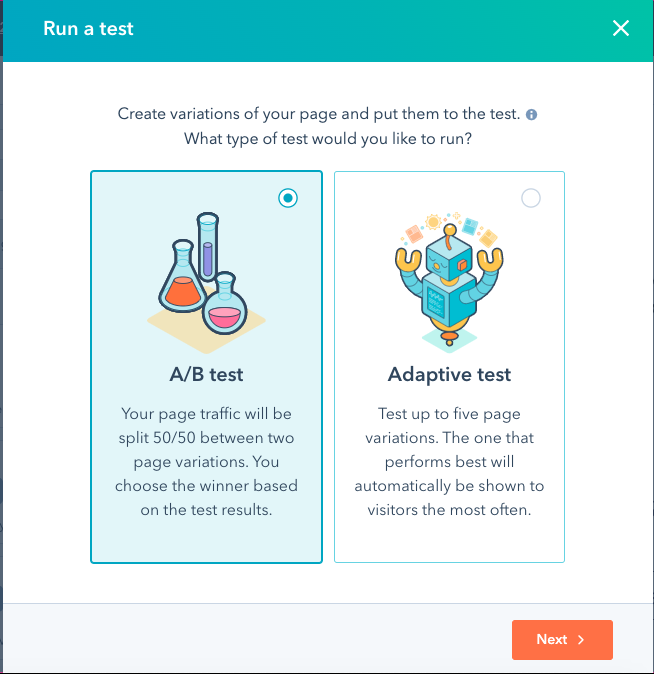
HubSpot lets you run an A/B or multivariate (Adaptive) test. As you're creating your test, you'll have the option to look at testing tips, like figuring out what to test. Since HubSpot has a drag-and-drop editor, and tons of modules to choose from, you'll have plenty of options. In the past, I've run tests for CTA buttons, images, headline copy, body text, and landing page layout through social media.
It's commonplace for CRMs to have tools for running social testing. Some offer a niche version of social testing; for instance, Mailchimp's are for emails. When you decide to use a CRM for testing, do some research to determine which one will offer you the tools you need to succeed.
But, if you don't know where to begin looking for software that offers social testing, here's a list of tools for your benefit.
Price: Free plan, or $800 for Marketing Hub Professional
With HubSpot's CRM, you can run A/B and multivariate tests. The tools are part of HubSpot's Marketing Software and are included in the Marketing Hub Professional and Enterprise plans. You can use HubSpot to test landing pages that are promoted through social media.
The CRM's drag-and-drop editor makes it easy to configure variables for tests. You'll have optimization features to make your page shareable and user-friendly, like social media badges. That way, when you promote the page on socials, your followers can share them with one click.
HubSpot's testing tool is accessible from the landing page dashboard via "Run a test" from the drop-down menu. From there, you can choose your test type and get started. If you want an easy-to-use platform that lets you create and analyze social tests, HubSpot is a great choice.
Price: Free plan, or $19-49/mo.
OptinMonster is a CRM that also offers built-in testing software. You can run A/B or split tests to increase conversions over time with tools that let you experiment with content, headlines, campaign triggers, styles, and layouts.
Once you set up the test, you can leave the software to do the work. It'll show your test content to website visitors and collect data on conversion rates. Your report will determine the number of impressions, acquisition, and page visits.
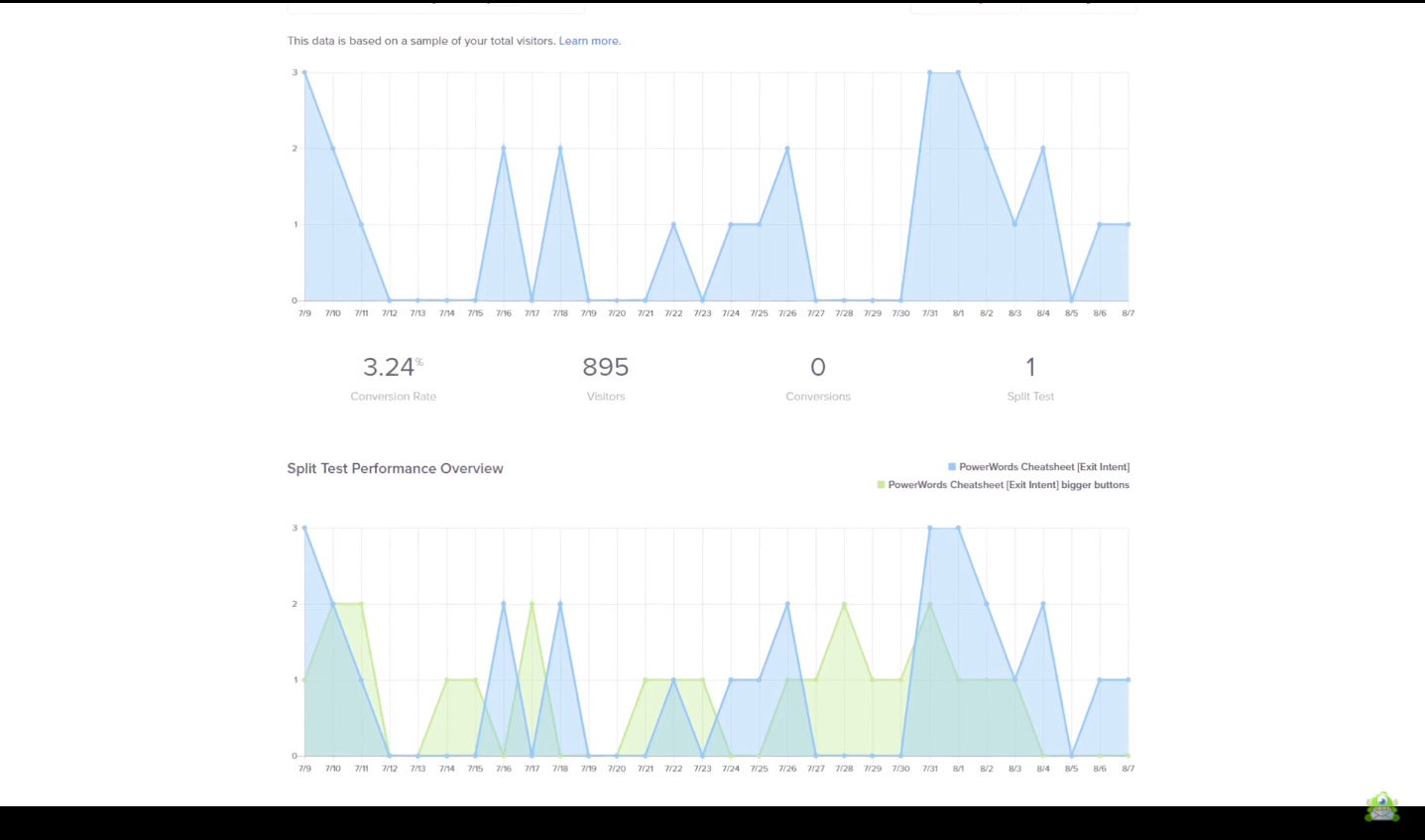
You can use OptinMonster's testing tool to test social media landing pages. Test the effectiveness of the landing page for your next ebook offer before it's published on LinkedIn, first. If you want a platform that offers intuitive tools for social testing, try OptinMonster.
Price: Contact sales for pricing
If you're heavily promoting your website on social media, test it to learn how it performs among your audience. One way you can do that is with Optimizely, which provides marketing software solutions.
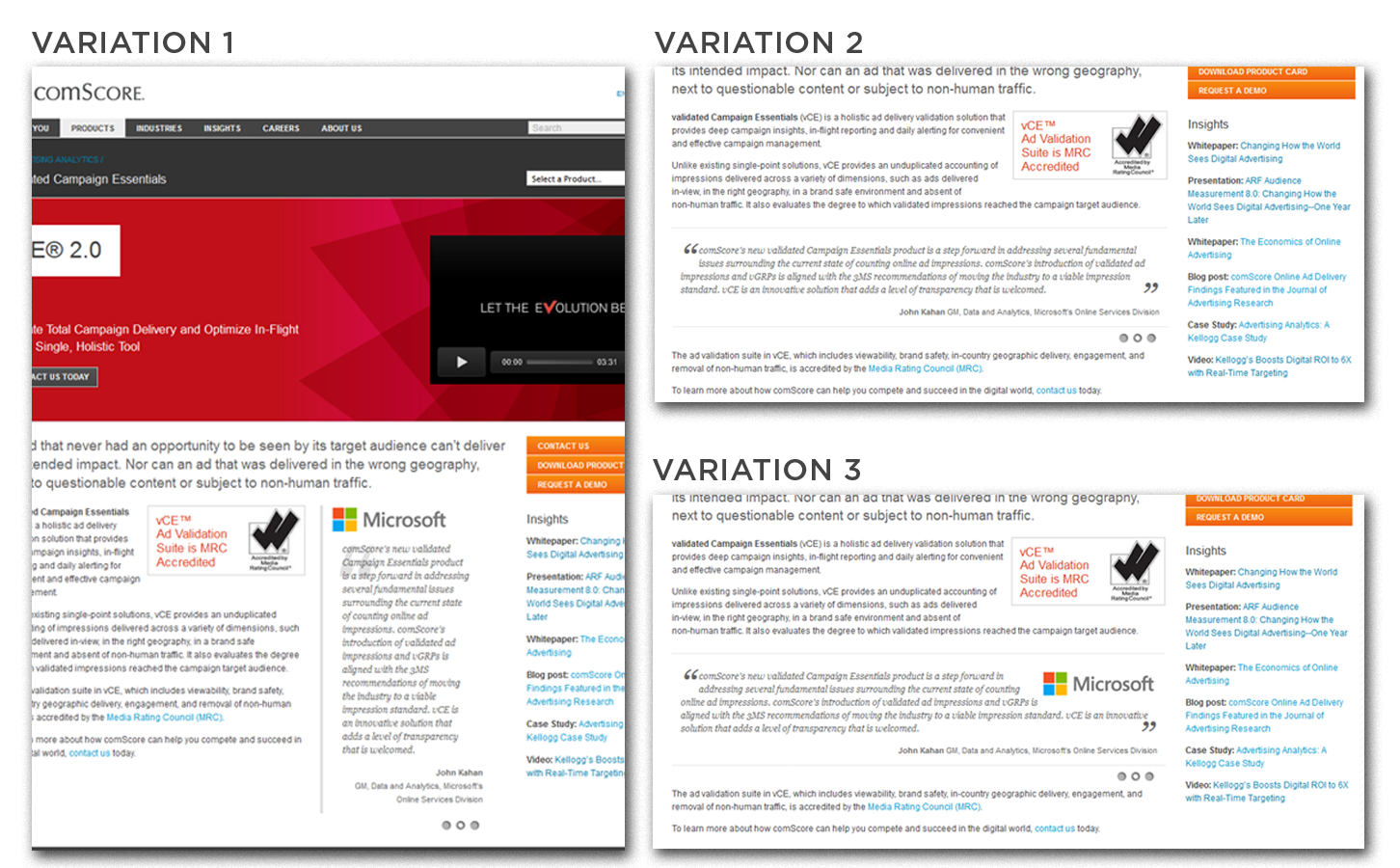
Optimzely's tools let you perform split and multivariate tests. Optimizely will count the number of website visitors and the metrics you pick, such as engagement, goals, conversions, and clicks. You'll be able to apply custom audience segments that can be filtered based on social proof performance.
Price: Free, or $48-$199/mo.
If you want a tool specifically for testing landing pages you promote on social media, try Leadpages. This is software that was made just for building professional landing pages. You can use the split testing feature with the tool.
When you run split tests with Leadpages, you'll be able to access its analytics the minute it aggregates traffic and engagements. At the conclusion, you'll get a report that includes the total and unique visits, conversions and total conversion rate. Your report will also include specific insights about test variations.
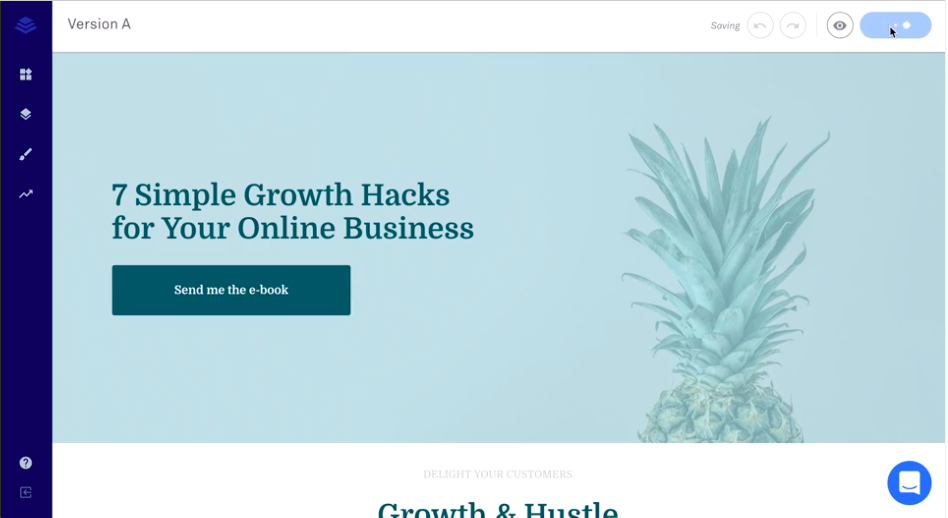
Keep in mind that you can't set a time frame for your tests. From the analytics dashboard, you'll be able to see how many days your test has been running. When you're ready for the test to be complete, you'll have to end it manually.
Price: Free, or $39-$499/mo.
Inspectlet was created just for testing. It's a software that lets you test multiple different content types, including web pages. You can also create content variations for future social tests, like edited graphics.
The visual editor in Inspectlet makes it easy to code or create different pages. You can change your page's design or code in real-time and access analytics as soon as the test begins. Inspectlet lets you track views, page elements, unique visitors, and custom events.
When you access your performance report, you'll get the metrics based on the goals you set. This can be anything from tracking clicks, user engagement, custom events, or URL views. Basically, anything that you can track with the software can be measured.
Now, you have a couple of options separate from social media sites that you can social test with. With this in mind, you're ready to run the test.
Think back to the example in the beginning of the post. Knowing all you do about social testing now, you're fully equipped to run a video engagement experiment of your own. Will it be on a social channel or with testing software?
One of the many great things about social testing is how creative they can be — you can social test just about any piece of content, and social media sites are starting to make that process easy. Testing your social ads ensures you're providing the most value to your customers, and now, you can.

A/B testing is one of those techniques that, if you have enough volume to give you significant results, is pretty much guaranteed to generate better results from your marketing.
Email marketers have known this for ages, but what drives me nuts is that they waste their time on tiny little tests -- instead of tackling some of the bigger, more exciting tests that yield real insights and improvements.
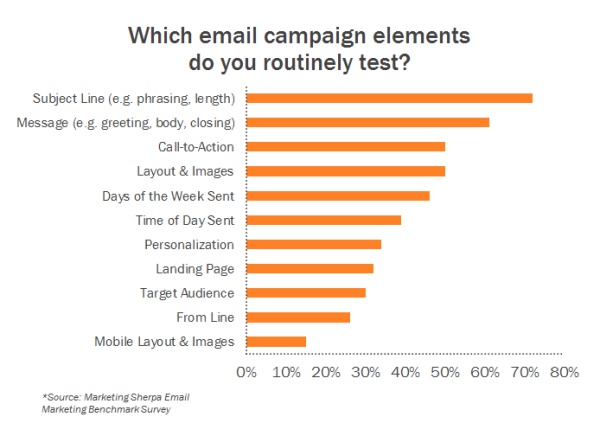
In fact, MarketingSherpa's email survey found that subject lines are still the most commonly tested element in email marketing. Meaning that those few words that get your subscribers to open your emails and see your wonderful offers are what marketers focus on most in their attempts to optimize their email marketing.
While I'm sure this strategy can end up getting you the most tested, optimized subject line that will ever reach an inbox, the impact of these tests are minimal compared to all the other things an email marketer could be testing.
So, are you ready to run some big, exciting tests?
In this blog post, we'll highlight the top email testing tools to try and what to test on them.
Possibly the biggest lever you have in your email marketing is not the few words you use to describe your offer, but rather, the offer itself.
Whether you're testing two ebooks against each other, or an ebook versus a webinar, this test is bound to get you better results overall. The reason this is particularly important is, while you may think your offer is the best thing since the iPod, you may also be wrong.
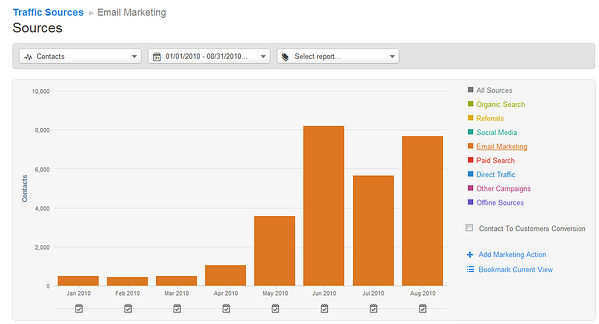
We started doing this sort of testing religiously back in the summer of 2010 and saw dramatic results. Instead of taking our email list and sending them all our latest ebook, we would take a smaller portion of the list, split it in half, send them each two different offers, and then send the better performing offer to the (larger) remainder of the list. This testing alone increased our monthly email leads 4-8x instantly.
Here are some more specific offer elements you can consider testing:
The goal of your email is not just to get someone to open or click through; it's also to take some action. For example, to download your offer. So don't think of your email in a vacuum. Think of it in the context of driving that particular action, which means optimizing where the action takes place: the landing page.
After all, if you create this great email that drives lots of clicks to your website but then you lose those potential leads at the last stage, it's like you've run the first leg of a marathon but then decided to drop out of the race during the very last mile.
Here are some important landing page elements to test:
The success of your email is not just dependent on what you're emailing or how you're emailing it, but also *who* you're emailing.
For HubSpot, an offer called, Agency Kit: How to Create Effective Ebooks for your Clients may get a great response from marketing agency owners, but it'd probably get a terrible response from the nonprofit marketers interested in our content.
The simple act of segmenting your email list to narrow your audience down to one that would find your content more relevant can have an amazing impact on your results.
Here are some audience segmentation tests you can run:
Check out this blog post for even more examples of how you can slice and dice your email list for better segmentation.
Changing up the format of your email can also have a surprising effect on your response rate. This could mean everything from the length of the email, to including a lot of images, to creating a simple, plain text email. Keep in mind that your results may differ depending on the type of offer.
For example, our new ebooks perform best when sent in a nicely formatted html email, while our free consultation offers perform better when sent as a simple, plain text email.
Here are some formatting elements you can test in your email marketing:
If you have a number of different email templates or design tweaks you want to test in a limited amount of time, you could consider A/B testing.
Timing is one of the most popular things marketers try to optimize. But it seems like there's more talk about the best time to send in general, and not enough testing going on to determine the best time to send email to your own subscribers -- or even a specific segment of your subscribers.
Even within HubSpot, we have segments of subscribers who respond more to emails on Mondays, Saturdays, mornings, afternoons -- on top of that, all in their own timezones.
Instead of sending email at every marketer's favorite time (Tuesdays at 10 a.m.), break away from the pack and see what works specifically for your audience in order to optimize for your particular business -- and to have a better chance of breaking through the clutter of other businesses' emails.
Consider conducting the following timing/frequency tests in your email marketing:
If you haven't tested a different sender name or address yet, definitely add this to your list. While best practices still apply (in other words, using a name that recipients will recognize as well as a real email address that your prospects can respond to), you can always try out different names to see how it affects your open and clickthrough rates.
Here are some sender name tests to try out:
HubSpot's free email tool allows you to create email campaigns that can be ent to email subscribers or contacts in your CRM.
.png?width=600&name=Email%20Editor%20(MHS-2).png)
Aside from providing an easy-to-use drag-and-drop software, HubSpot also allows you to test email designs through an A/B test feature. The software also provides tips related to length in the subject line and preview text area which can help you write captions and instantly verify that they won't get cut off.
On top of all these features, HubSpot's software will notify you if it can't find a link in your email. It will also warn you when inboxes like Gmail will trim your message.
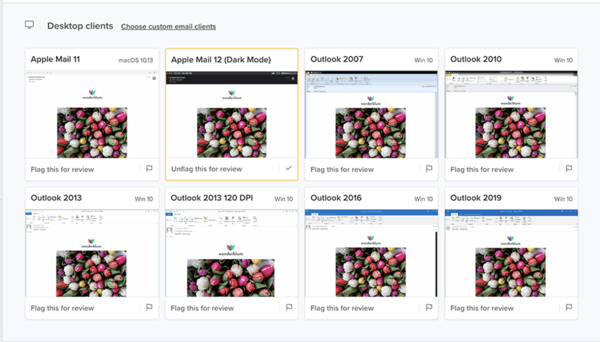
Ever wonder if your email will look aesthetically pleasing on different devices and in different email provider inboxes? With Litmus, you can sign up for free and send them the email you want to test. From there, Litmus will automatically review the email and send you screenshots showing what your message will look like to readers using different email providers.
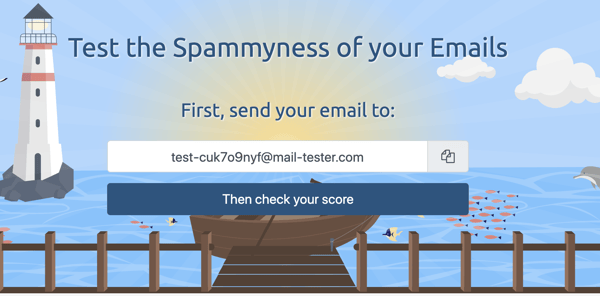
Worried you're using phrases or wording that could trigger spam filters to burry your email? With Mail-Tester, you can log in and get a special email address to send your test email to. After you send it, Mail-Tester will send you a report that notes any of the spammy trigger words that were in your message so you can correct your language before sending to your full list.
Sometimes, if your IP address is associated with sending many different email newsletters, email providers might move your email to spam. If you suspect that your IP address could be negatively impacting your email numbers, you can use SenderScore to find out if your IP address is considered "spammy."
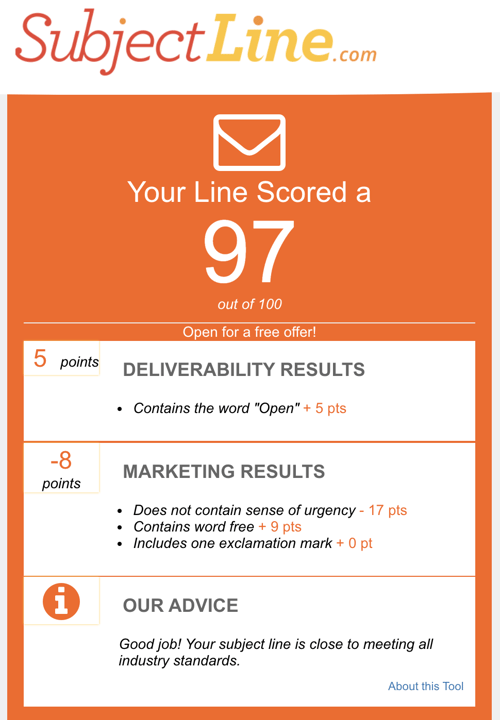
If you need help with writing subject lines, you can test a few before sending your email with SubjectLine.com. When you go to the website, you simply type in a subject line and click the submit button. Then, you'll receive a grade out of 100 points as well as pointers for improvement.
Reminder: Test only one thing at a time.
The key with any of these tests is to test just one element at a time so you can isolate your variables and thus tie the difference in results is to that particular change. And if you crank through this list of BIG email tests, here are some great ideas for quick, smaller tests.
Editor's note: This post was originally published in December 2012 and has been updated for comprehensiveness.

