Please visit Search Engine Land for the full article.


from Search Engine Land: News & Info About SEO, PPC, SEM, Search Engines & Search Marketing https://ift.tt/2VDDNvt
via
One of the first things you're taught in your Introduction to Marketing class is that marketing can be best explained using the marketing mix — also known as the four P's.
They are — and say 'em with me, because if you took that class, you know these four words by heart:
One of the first things you're taught in your first marketing internship or job, however, is that marketing entails so much more than can be simplified in a four-section marketing mix matrix.
Still, there's an undeniable benefit of marketing teams organizing their work into the marketing mix framework.
When you stray too far away from the four P's, it can be easy to lose focus on your purpose as a marketer.
Marketing truly is about teams and individuals working together to promote a product in the right place at the right price point. Efforts beyond this scope are essential, but they do all stem off of this foundation of the marketing mix.
Here, we're going to dive into what a marketing mix is and how to develop a successful marketing mix strategy for your own company.
The marketing mix refers to the actions a company takes to market its product(s) and/or service(s). Typically, it acts as a framework for breaking down the four key components of marketing — product, price, place, and promotion.
The marketing mix helps companies organize their marketing initiatives by task and department for more process-driven and impactful marketing campaigns.
This framework has roots back to the 1940's and has been evolving ever since. While some elements have been added or tweaked over the years — most notably for the modern digital age — the core elements of the marketing mix (i.e. the four P's) have remained consistent for decades.
Need a way to visualize your marketing mix to share it with your employees or investors? Use these four marketing mix templates to organize your initiatives and activities by the right section. Click here to download them now.
The core elements of a marketing mix are product, price, place, and promotion — known as the four P's of the marketing mix. When perfected and synchronized, these elements provide a well-rounded approach to marketing strategy.
Product refers to what your business is selling — product(s), service(s), or both. The bulk of the work in this element is typically done by product marketers or managers. Nailing the product element of the marketing mix means doing extensive research and development, understanding the need for the product, developing a product launch plan and timeline, and educating customers and employees — especially salespeople — on the product's purpose.
Price refers to the price point at which you'll sell your product(s)/service(s) to consumers. Arriving on this dollar amount requires consideration of multiple pricing strategies, analysis of similarly priced products in your market, and insights from consumers through surveys and focus groups. Price speaks to positioning in the market, the speed at which you want to penetrate your market, and your company's revenue goals and profit margin.
In the marketing mix, place refers to where your product or service will be sold. For tangible products, this will include physical locations such as your own store, or a retailer where your product will be resold. It can also include the other methods where your products can be purchased, like online or over the phone.
Promotional activities are those that make your target market aware and excited about what you're selling. While this does include paid initiatives like commercials and advertising, promotion also entails organic initiatives like word-of-mouth marketing, content marketing, and public relations.
While the marketing mix can often be simplified down to the 4 P's, the expansion of the scope of marketing in recent years has resulted in more P's added to the list.
For example, Smart Insights includes the following elements in its marketing mix definition:
Some of the other P's can include:
These other marketing mix elements should be utilized as you see fit for your projects. However, every good marketing mix should rely on a thorough exploration of those first 4 P's of product, price, place, and promotion.
Because the marketing mix incorporates elements from across your department — and even your company — it's imperative to establish a marketing mix strategy for each product you launch, or for your company as a whole. For a fully-fleshed out marketing mix, follow these steps.
The success of your marketing work is first and foremost contingent on your product. Make sure it's well-developed and your team can speak to its benefits and the story behind it.
Best practices in this step include:
Taking these actions ensures you're making every effort to understand and solve for your customer, providing a solid foundation for your product to launch successfully.
Featured Tool: Market Research Kit. To make your R&D more impactful, use these free market research templates so you can better understand your customers and competitors.
A lot goes into choosing a price point — so much so that we wrote an entire guide to pricing strategies.
Luckily, you'll be able to refer to much of the work done in the previous section. Thanks to your understanding of your market through research, you'll have answered most of the necessary questions in this section. You'll also need to take your costs into account so you can maximize unit sales and profit.
During this stage, make sure you do the following.
Featured Tool: Pricing Strategy Calculator. If you need help selecting your pricing model, use this template to compare different pricing strategies and see which will yield your company the most profit and revenue based on your forecasts.
The place part of the marketing mix answers where your product will be sold. Keep in mind, this can be any combination of your store, a distributor's store, or online. You'll want to address the following points before moving onto the promotion stage:
Finally, it's time to promote your product. While this is probably the element most associated with marketing, it's crucial that this element be completed last, because you need the foundation of product, price, and place before determining promotion tactics.
Think about it — shouldn't you know what you're promoting, why you're promoting it, and where it's available before actually promoting it? It's tempting to jump right to this step, but your promotion will be much better off if it's done after everything else in the marketing mix.
Once you do have that understanding, consider the following promotional channels and choose the one(s) that make the most sense for your product, its buyers, and its price point:
Featured Tool: Marketing Plan Template. If your promotional tactics are multi-faceted enough, consider documenting your plans in this customizable template.
Every company's marketing mix is different, placing emphasis on certain factors over others.
Some businesses use their marketing mix for a single product, while others adopt a company-wide marketing mix. However, all examples of good marketing mixes never fail to neglect the word mix. All elements of the marketing mix are important, so don't be quick to overlook any of them, and find ways for different elements of the mix to overlap and share goals.
With so many activities happening to support a single initiative, it's helpful to organize everything in a single template for easy reference. Here are a few examples of marketing mix templates your marketing department can use, in addition to when they might make sense to reference.
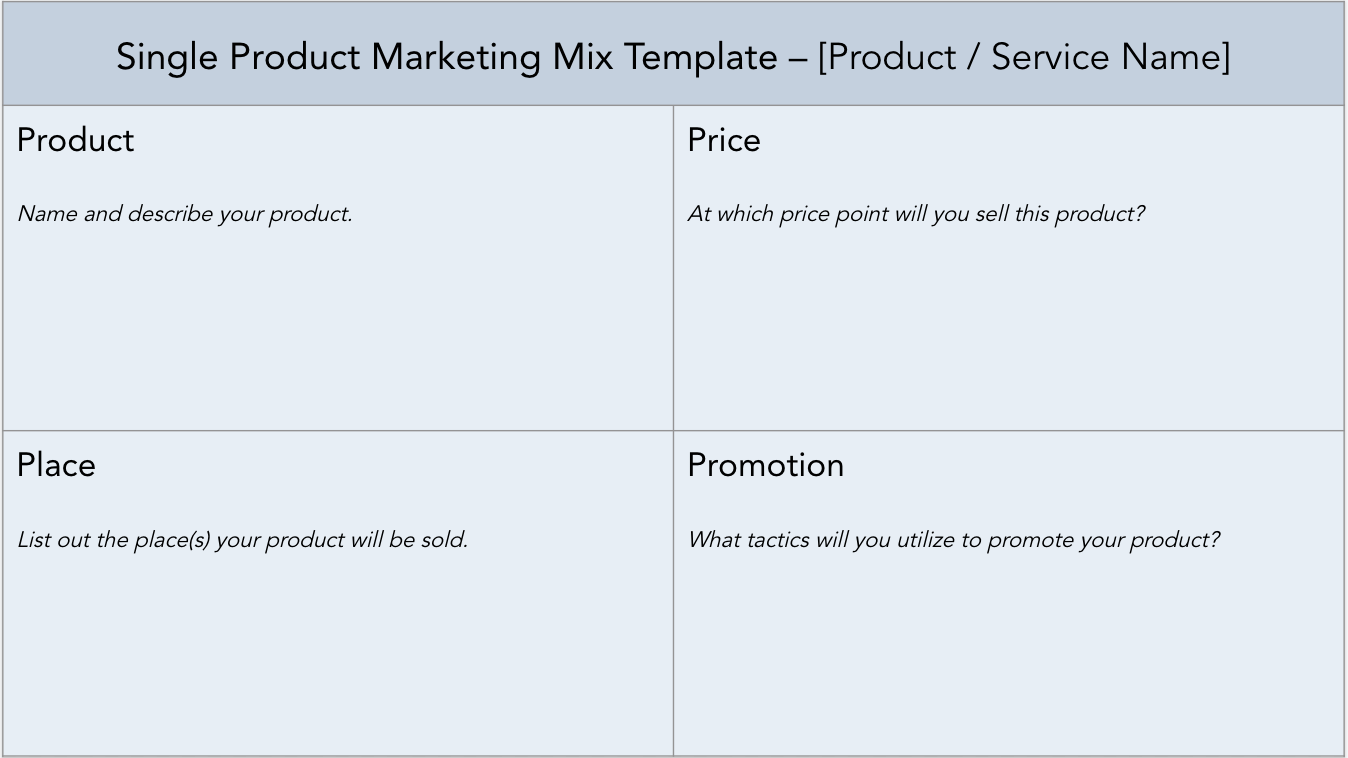
This template is a great starter for organizing a marketing mix. It's ideal for one product and for the marketing mix's maker to get an understanding of all the elements involved in the marketing of a product.
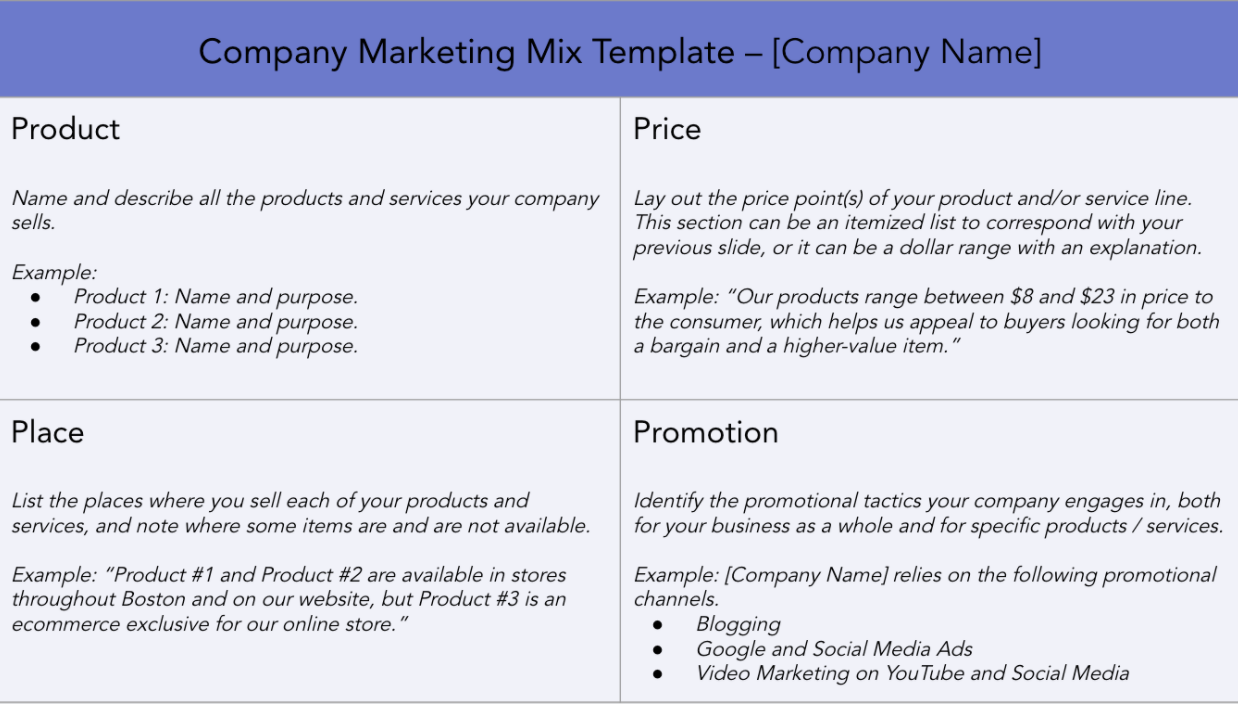
For a marketing mix that applies company-wide, this template is a perfect fit. You can outline the initiatives that apply to most or all of the products and/or services in your suite.
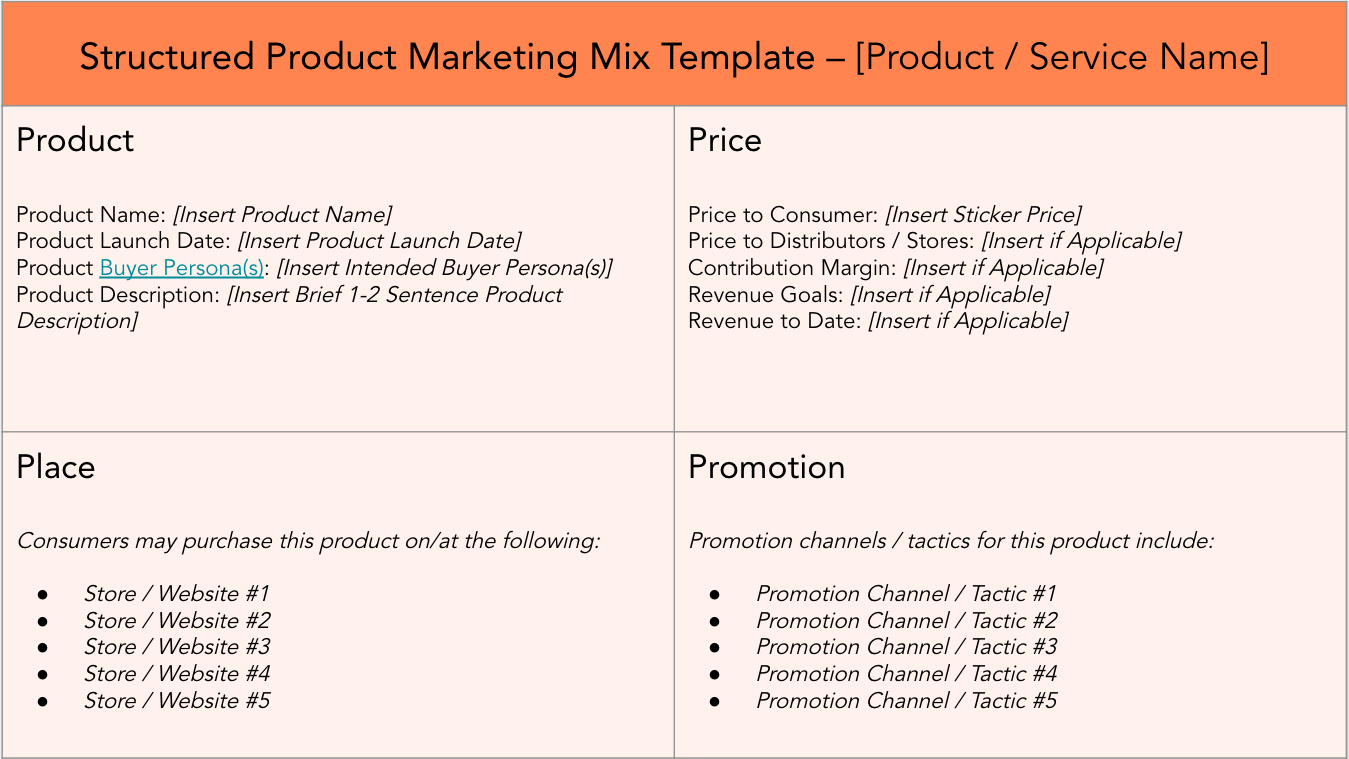
For when you need to get right to the point with a more organized, actionable visualization, use this structured, bulleted template for quick reference and clarification.
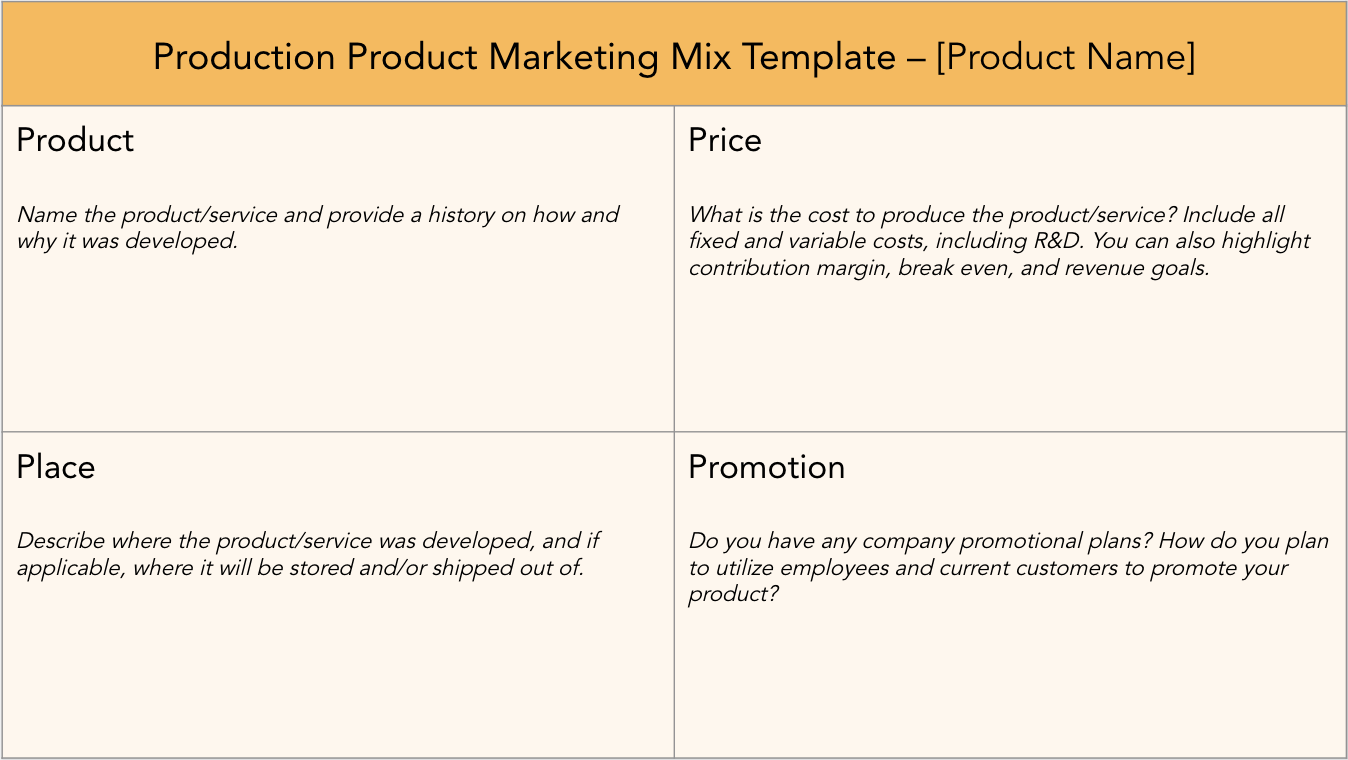
Finally, a production marketing mix template is best utilized for internal reference. This template answers questions on the go-to-market efforts for products and services that you're selling.
Whether you're a student just learning to understand everything that marketing entails or a CMO hoping to clearly convey the work that your team is doing to your fellow employees, the marketing mix framework is an essential tool to help you get the job done.
Don't forget — if you need to organize your marketing initiatives into a central location, try using HubSpot's Marketing Mix Templates to document your activities in one place.

As William Shakespeare once wrote, "To be or not to be, that is the question."
Marketers have a similar classic debate and that is: gated versus ungated content.
While 80% of B2B content marketing assets are gated and lead generation is one of the top objectives for marketers, it's not an open and shut case.
That's why we've gathered everything you need to know about gated content in this post.
Below, let's review what gated content is and how it compares to ungated content. Then, we'll dive into gated content best practices and look at some examples.
So, how does gated content work?
Usually, users arrive at your website and see a CTA or pop-up that offers them access to a piece of content in exchange for their information.
Your CTA or pop-up could lead to a landing page where the visitor will get more information on the content offer.
It's important to note that gated content for inbound marketing is free and not hidden behind a paywall. Users just need to submit contact information to access the content.
Now, you might be wondering, "Why would I hide my content from my audience?"
Typically, the goal of gated content is lead generation. Marketers will create targeted content for their audience and use it to attract leads. Gated content isn't used for brand awareness or visibility campaigns because the nature of hidden content doesn't allow for high traffic.
Below, let's discuss the pros and cons of gated versus ungated content.
As you can probably tell, gated and ungated content both serve different purposes. But you might be wondering what the pros and cons are. Let's dive into it now.
Ultimately, gated content is meant to generate leads that you can nurture into prospects through your marketing efforts while ungated content is meant to increase traffic and improve trust with your audience.
Both types of content are valuable and should be included in your content marketing strategy.
After reading this list, you might be wondering, "How do I know if I should gate my content?"
Well, it all depends on your goals -- brand visibility/SEO or lead generation.
Additionally, consider the type of content. Longer form content like an ebook is suited to gated content, while shorter form content such as blog posts are better off as ungated content.
Once you've decided to create a piece of gated content, you're probably curious how to get started. Let's review some best practices below.
When a prospect goes through the buyer's journey, they'll go through three stages: awareness, consideration, and decision.
In fact, here's a quick graphic explaining each stage:
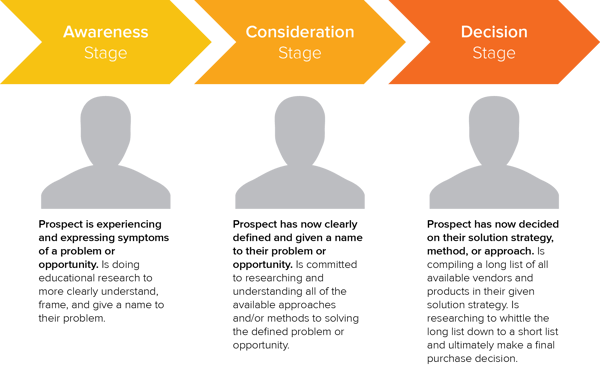 During each stage, it's important that your audience has content that's meant to help them along the way.
For instance, visitors in the awareness stage are probably interested in reading an ebook. On the other hand, a visitor in the decision stage might prefer a product demo or webinar.
That's why it's important that your content offers are designed for each stage of the buyer's journey. If your gated content is aligned with their journey, your audience is more likely to convert.
Once you've brainstormed some content ideas for each stage of the buyer's journey, it's time to conduct a competitive analysis.
In a competitive analysis, you'll research what your competitors are doing. This means looking up what type of content offers they're creating. Look at what content is gated versus ungated.
This will give you a good idea of what content of yours should be gated.
As an inbound marketer, you know that providing value is of the utmost importance.
Your content offers shouldn't just be a long blog post. Instead, your gated content should provide actionable, valuable content.
Additionally, your gated content should be relevant to your audience.
When your content provides true value, it gives your audience an incentive to fill out that form and give you their contact information.
Usually, when a user clicks on a CTA for a content offer, they'll be led to a landing page. That means one of the best practices for gated content is to build a strong landing page.
This means you'll want to create a strong headline, write compelling copy, and generate a form.
Ultimately, a landing page will eliminate distractions and capture your visitor's undivided attention.
Once your audience has downloaded your gated content and you receive their email address, it's time to segment your email lists.
This will help you develop email marketing campaigns that are targeted and effective.
Additionally, segmenting your audience means you can send nurturing emails to move those leads to prospects.
When you've decided to gate a certain piece of content, that means you can track conversions and measure your analytics.
As with any marketing strategy, measuring your success is extremely important. This data will help you understand your audience better and improve your content strategy.
Now that you know some best practices for creating gated content, let's look at types of content and examples of what this will look like in action.
A great example of gated content is a white paper. A white paper is an authoritative, in-depth report on a specific topic.
Usually, these are long-form pieces of content that are interesting and valuable to your audience.
White papers make great gated content because of the value they provide. Additionally, it helps your brand become an industry expert on a topic. When you're a trusted expert, people want to know what you have to say.
This means you'll get more people to download your offer.
An ebook is another popular type of gated content. Unlike a white paper, an ebook is usually a shorter guide on a specific topic.
Ebooks can also give your brand authority and build trust with your audience. Usually, ebooks are used in the awareness and consideration stage of the buyer's journey.
One of my favorite forms of gated content is the template. Providing a template is a tactical, actionable piece of content.
The perceived value of a template is much higher than that of an ebook and a white paper, which means your audience is more likely to input their contact information to receive it.
Templates are a great gated content offer for folks in the consideration and decision stage of the buyer's journey.
With a webinar, you'll educate your audience to learn more about a topic. You'll develop trust, build relationships, and hopefully, inspire.
For prospects who are in the decision stage of the buyer's journey, webinars are an excellent gated content offer.
Again, webinars have a high perceived value, which makes your audience more likely to fill out that form.
With gated content, it's important to consider what types of content you're offering and make sure it's suited to your audience. Ultimately, gated content should be targeted and help you generate leads.


