Please visit Marketing Land for the full article.


from Marketing Land - Internet Marketing News, Strategies & Tips https://ift.tt/3bd5Nia
via


Do you read every post on a blog? If you're like me, you visit sites for a specific reason — be it the New York Times crossword puzzle or the latest gear roundup from Outside. You know what you're looking for when you click. That frame of mind is why blog categories help readers navigate your site.
But what categories should you choose? How do you name them? And what's the difference between categories and tags?
Let's cut the confusion with blog category best practices that keep readers combing through your content.
For example, imagine you run a food blog. You create recipes, write reviews for appliances, and share photography tips. These main topics (recipes, reviews, photography) are your blog categories. But within each topic fall a handful of sub-topics like bread and pastry recipes, small appliance and tool reviews, and low lighting and stop-motion photography tutorials.
If I'm visiting your site for dinner inspiration, I should be able to quickly click your recipes category to view all of the tasty options you have to offer.
No matter what kind of blog you run, the content you create needs to fall under one of your chosen categories.
You put hours of work into each blog post, and you don't want it to disappear into the black hole of your archives. Without defined blog categories, your content quickly sinks out of view — only to be found by endless scrolling. Preventing this from happening is only one benefit of categories.
A visually appealing site is incredibly important for visitors. 90% of people have left a website due to poor design. Blog categories group content under a handful of topics, so people get to where they want to be, fast. Some website themes limit the number of categories you can create, so make sure to consider that before grouping your content.
Categories give you a leg up in the blog SEO game by adding hierarchy to your pages. This helps search engines better understand what each page is about and rank accordingly.
If you create a category page, for instance, and continue adding and linking posts that are relevant to that category, it will become increasingly optimized. Search engines will recognize this and bump up the ranking, which makes it easier for people to find your site.
Planning an editorial calendar is no easy feat. But with well-defined blog categories, you have a guide for what to write about. Your strategy can touch on each category to avoid stacking one with all the content. This rounds out your blog and prevents you from falling into single-category chaos.
If that's not enough to sway you, know that 65% of the most successful North American bloggers have a well-documented content marketing strategy. Among the least successful bloggers, 39% admit they don't have any strategy and 14% actually write down a strategy.
Every blog is unique, but it's worthwhile to look at others for inspiration. Here are a few examples of how different sites sort their content into blog categories.
Since you're already here, let's take a look at how this blog is organized. The main categories are Marketing, Sales, Service, and Website. But within the Marketing category, for example, are sub-topics like social media, branding, SEO, and digital marketing.

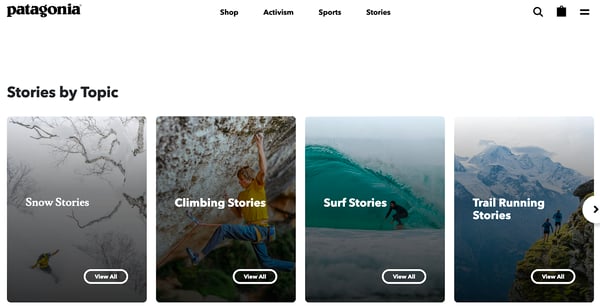
Outside of their product website, Patagonia runs a blog called The Cleanest Line. It's broken down into the following categories: Stories, Films, Books, and Activism. You can search deeper by clicking on sub-topics organized by sports like kitesurfing, climbing, and trail running.
Personally, I go for the cartoons. But The New Yorker has a lot to offer, which is why they sort content into 10 categories: News, Books & Culture, Fiction & Poetry, Humor & Cartoons, Magazine, Crossword, Video, Podcasts, Archive, Goings On.

I could scroll through this site all day, but it's easy to navigate thanks to five categories: Recipes, Cookbooks, The BakeHouse, Drake on Cake, and Workshops. Joy infuses her personality into the names while still making it clear what she's all about: delicious baked goods.

Maybe you've grouped all your posts under one category and gone tag crazy to create some sort of structure. You're not the only one. The world of tags and categories can be confusing. But now is the time to learn the difference between the two so you know when to use one versus the other.
While categories and tags help organize your site, you already know categories are the high-level topics to guide readers where they want to go. Categories usually make up your navigation bar or are displayed on a sidebar for people to see. The fewer categories you have, the better. This is especially important if you're running a niche blog, because it helps you stand out from the other sites in the space.
There's no hard and fast rule for the right number of categories, but most niche blogs have between three to five, while larger sites have around five to ten categories. The New York Times has 19 categories, but this is definitely too many for most businesses. The larger the number, the more difficult it is to stay organized.
On the other hand, a tag is an indicator of what a particular post is about. It's one to three words that sort your post into a particular archive. It's not typically shown on your site, but helps search engines find your posts.
For instance, this post falls under the Marketing category, but it's also organized with a tag for Blogging so that you can easily navigate to other posts on the topic at the very bottom of this post. With tags like this, our post now pops up when you're looking for information about naming blog categories.
Choosing tags is simple — start with the keywords you already plan to use for a post. If you’re using a pillar/cluster model like we do, you might even consider naming the tags after the pillar or cluster your piece(s) will sit under.
Or, simply use existing words people may type into search that relate to your post. Avoid tags with the same names as your categories to prevent overlap. Aim for less than 10 tags per post. And don't make up words unless it's a strategic part of your blog or brand strategy.
Now that you have a better understanding of tags and categories, it's time for strategic fun: choosing category names.
Choosing names for your categories starts with one major factor: analytics. Yes, really. Even if your site is whimsical or totally unique, creating strong categories requires data.
What articles are getting the most views, comments, likes, or shares? If you know what people love about your blog, you'll have a better idea of where to focus. It also helps to look at what topics aren't resonating with your readers, especially if you had considered them a priority in the past.
It's time to whittle down your topics. There's no ideal number, but between three to five categories gives you enough breadth without being too overwhelming to manage. Some bloggers prefer five to eight categories, while news sites may have around eight to ten. The number is up to you. Just consider your content, your strategy, and your time. Blog categories are meant to make writing easier, not more complicated.
For some people, choosing names will be easy. Of course, food blogs always have a Recipes category. But this is the time to think about your unique brand and what you want to present to people.
For instance, the food blog Kitchn has categories for Recipes, Holidays, Meal Planning, Learn, Shop, and People. This site is mainly for an audience who cooks often, plans ahead, hosts holiday meals, invests in quality cooking tools, and is inspired by famous chefs. Know your readers, and cater to what they want. Just don't get so creative that people have no idea what your content is about.
Be consistent in style and structure. Remember how bad design scares away readers? Inconsistent categories play a part in the overall look and feel of your blog, so keep them as similar as possible. This includes capitalization and use of nouns, verbs, or adjectives. Not every category has to be exactly the same, but you don't want one to be a six-word question while another is a one-word noun.
If your blog has been around for a few years, you may have some serious organization to do. Blog categories are a great way to start sorting. Consider what categories your readers enjoy best, and get rid of any with only a few posts. Trimming down categories isn't always easy. But it's definitely worth the effort for a site that's simple to navigate and build a strong content strategy around.

Let’s face it, we love videos.
Videos of cats, babies tasting lemons for the first time, food recipes — you name it, we love it. And when it comes to marketing, this still rings true. Recent data shows that video content is one of the most influential forms of marketing out there.
A 2020 study by Wyzowl reported that people share videos at twice the rate than any other form of content. It also found that 84% of people were convinced to buy a product or service based on the brand’s video.
More recently, short-form videos have taken over social media platforms.
So, how can you leverage short-form content to grow your business? And what are some trends to look for in 2021? See what HubSpot marketing experts are saying, below.
But there's no universal number that everyone has agreed on. For instance, a short-form video on Twitter can be up to 2:20 minutes. On TikTok and Triller, it's 60 seconds. On Instagram Reels, it’s even shorter: 30 seconds.
Brandon Sanders, a digital marketer for HubSpot Academy, highlights that what's considered short-form can also depend on the platform.
"With the rise of platforms like TikTok, Reels, and Vine, short form video is actually getting shorter and lending itself more to 60-second to two-minute videos," he said. "I think the perception of short-form content on platforms like YouTube is actually around that 10-minute sweet spot because content on YouTube tends to be more comprehensive and longer."
So, when you’re thinking of short-form video, Youtube is the exception, whereas TikTok and other growing short-form videos are the rule.
Aside from length, one thing that set short-form videos apart is the trend culture. TikTok, for instance, is run by dances, sounds and social challenges. So, to get on the "For You" page on TikTok — which is equal to the "Explore" page on Instagram — brands must often join in on the fun.
Sanders says short-form videos give creators an innovative way to showcase their content.
"The growth of social media is causing the human attention span to become shorter and shorter," he said. "So, leveraging the power of short-form content will give you a leg up on your competition and help engage your audience."
As with any new trend or platform, HubSpot Senior Content Strategist Amanda Zantal-Wiener says you should always consider your audience first.
"It all goes back to a very old question: Which channels are your audiences using and for what?" she said. "And therefore, for which channels does it make the most sense for your business to create this short-form content?"
This means that while short-form video is often known for its entertainment value, you can adapt it to align with your brand.
Consumers generally love UGC. In fact, it influences their purchasing decisions more than brand- or influencer-generated content. Without using up too many resources, brands can publish videos that evoke emotion. Another benefit? It’s budget-friendly.
@chipotleOut of this world delivery ha @cheekyboyos #chipotle #burrito #space #fyp
♬ original sound Chipotle
This is a great example of how you can leverage user-generated content in your strategy. In this instance, Chipotle collaborated with these content producers to create a fun, viral-worthy video.
One of Chipotle’s target audiences might be young, college students looking for inexpensive meals. This video features two creators who reflect the audience they may want to attract. Brands should keep this in mind when considering UGC and ask, "will my audience relate to this?" If the answer’s "yes," move forward.
Consumers seek out authenticity and transparency in brands. With short-form video, you only have a few seconds to connect with your audience.
So, how do you do that? Well, there’s no exact science to it, but consumers tend to feel more connected to brands that show the people behind the brand. In one Sprout Social study, 70% of consumers said they felt more connected to brands whose CEO is active on social media platforms.
So, going into 2021, brands should pull back the curtain and engage with their audiences on a more personal level.
@sierranicoleofficialText letsgrow to 81257 for biz credit tips ☺️ #entrepreneur #businesstiktok
♬ Sean Kingston feat. Chris Brown & Wiz Khalifa- "Beat It" - TBT 24/7 🎵
Trendy? Check. Informative? Check. Prompts action? Check! This video works because it has all the ingredients for an effective short-form video.
It first grabs the viewer’s attention by including a popular song and dance. The content addresses pain points viewers may be facing. Then, the call-to-action (CTA) in the caption rounds out the video by turning viewers into potential leads.
In 2021, brands will likely focus on educational content in their short-form videos. Think how-to’s, DIYs, and explainer videos. A 2020 Wyzowl report found that viewers want to see more of this video style from brands.
Educational videos are great added-value content because they help audiences in their day-to-day lives. Brands that make education a priority in their marketing strategy can improve lead generation and build stronger brand loyalty. Similarly, explainer videos target users who are at the decision-making stage of the buyer’s journey and, if done right, they can turn decision-makers into customers.
It’s a win-win situation: Brands get to address their audience’s pain points and offer solutions, which is (surprise!) them. Not sure what I mean? See the example below.
Soy Yo Candle used this formula to create this short-form video. Presumably, one of the biggest struggles of owning candles is making them last. In just a few seconds, the brand presented a problem, offered a solution, and promoted their product. It can be as simple as that.
Another highlight in this video is that it caters to viewers who may be discovering the brand and those who already know it. Because of the value it offers, the brand can reach a broader audience organically.
Short-form video requires taking a more authentic, human, and creative approach to marketing. Kelsi Yamada, an associate marketing manager who works on HubSpot’s social media campaigns, says it's a low-commitment and engaging way to connect with your audience.
"You can get a good laugh or learn something new in a minute or less on TikTok or Reels," said Yamada. "On the flip side, it's also relatively easy to create, which means there are more people who can share their humor or points of view. Because of this, brands should figure out what their unique point of view is, and how they can stand out in the noise."
The desire to be on-trend is always tempting. But Yamada stresses that brands should be selective about which trends they partake in.
"Not every viral TikTok sound or meme format will align with your content strategy or brand, so don't force it," she said. "Focus on catering to your niche and staying authentic first. Don't be afraid to make something completely from scratch – trends have to start somewhere!"
With this in mind, it’s all about finding the balance between what’s trending and what’s on-brand for your business.
With 69% of its users between 13 and 24 years old, TikTok is definitely the platform of the Millennial and Gen Z population.

The TikTok homepage features a timeline of videos separated in two tabs. The "Following" tab with videos posted by the user’s followers, and the algorithm-driven "For You" page based on user behavior (what they like, comment on, scroll past etc.)
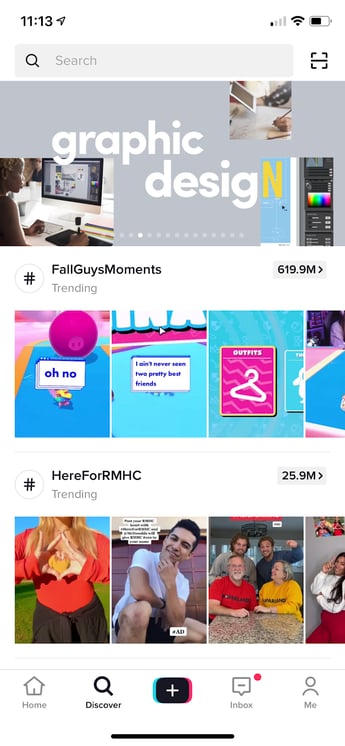
The "Discover" tab on TikTok highlights trending topics and hashtags, a great resource for marketers to generate new content ideas.
B2B marketers have been wary of using the platform, but it could be because success on the platform relies on emotional appeal. Yet, that emotional appeal may be exactly what they need.
According to a LinkedIn study, B2B strategies that appeal to emotions are seven times more effective for revenue generation than "rational messaging."
So, it may be time to start practicing those dance moves.
Some call it TikTok 2.0, but Instagram Reels is proving to be its own beast.

The Reels tab on Instagram is a scrollable video timeline, similar to what users see on their Explore page. From this page, users can click on the music the account used to see what other Reels feature that sound.
With over 1 billion active monthly users, Instagram already had consumers’ attention. When they launched Reels back in August of 2020, it became another marketing tool for brands and a worthy opponent for TikTok.Instagram caters to a broader age demographic than TikTok. And when considering their other marketing features, Reels is another way for brands to expand their reach in 30 seconds or less..
Triller is Tiktok’s musical theater friend (or rival), the one who bursts into song anytime, anywhere without cause or notice.
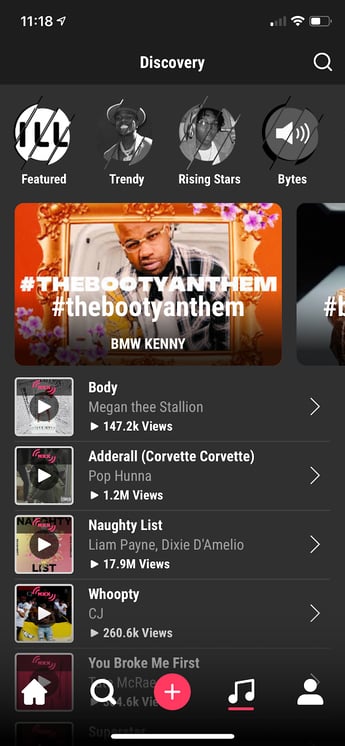
Triller’s homepage looks similar to other short-form video platforms. However, They have made music a prominent feature on the app by making top and trending music a main tab.
The platform is popular among musical artists and allows users to edit 60-second videos within the app. This includes music, filters, effects, and transitions. Triller grew in popularity earlier this year when there was some uncertainty surrounding a TikTok ban in the United States.
The app reports having 13 million active monthly users who spend an average of 20 minutes a day on the app. With music playing a key role on the app, marketers should use music as a storytelling element in their videos.
For instance, the song "You Got It" by Vedo, a song about unlocking your potential, has been making its rounds on Triller. A recruiting firm could use that sound to create a short video targeting job seekers. The song would also work great as a backdrop for a business coaching company advertising its services. The limit does not exist.
If you want to take short-form video content beyond social media, there’s Hippo Video. The video marketing platform gives brands a one-stop shop to produce, distribute, and analyze their video content. Users can also embed forms, CTAs, and annotations within the video, making conversions easier.

For example, let’s say a SaaS company is launching a new product and the marketing team is using Hippo Video for the email campaign.
On launch day, they can send a product teaser video to current customers and include a "Schedule a Demo" CTA, leading users to a meeting scheduling page. During the campaign, the team can track key metrics like total plays and average watch rate — taking video analytics to another level.
Vimeo recently acquired Magisto, a video editing software that makes video marketing easy through artificial intelligence (AI).
The first step is uploading your videos. The software will then analyze the videos and put it together based on the video editing style you’re looking for. They have over 10 editing styles ranging from real estate and fitness to Facebook and YouTube ads.
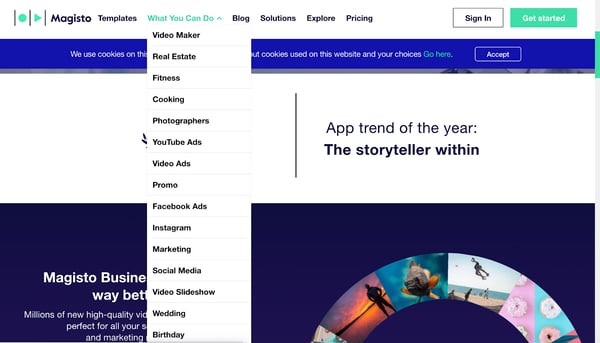
Once you select the style you’re looking for and the video is complete, you can distribute it on social media platforms and track the analytics.
This platform is ideal for brands that don’t want to spend too much time or too many resources on video marketing. This app does it so you don’t have to.
There are hundreds of ways to incorporate short-form videos into your marketing strategy. But no matter which trends come and go, it will always come back to your audience. Try a few approaches, and listen to where the data tells you to go next.


