Please visit Search Engine Land for the full article.


from Search Engine Land: News & Info About SEO, PPC, SEM, Search Engines & Search Marketing https://ift.tt/3n3Slmq
via


When you're working at a new job or trying to get a promotion, you need to be organized. While you might list organizational skills on your resume, putting that skill into action is a little harder.
Having organizational skills means that you can meet deadlines and be efficient in your workflow management. In fact, organizational skills can be synonymous with energy and time management in most cases.
All of these skills are very important in the workplace and potential employers want to make sure you can stay on top of things.
In this post, we'll dive deep into what organizational skills are, specific examples of what they look like in action, and how to develop organizational skills in the workplace.
![→ Click here to download leadership lessons from HubSpot founder, Dharmesh Shah [Free Guide].](https://no-cache.hubspot.com/cta/default/53/4e634041-e1ce-4a85-8e65-aea12fc10b84.png)
Organizational skills are about building structure, boosting productivity, and prioritizing the right tasks at the right time.
The antithesis of organizational skills is procrastination, clutter, inefficiency, and miscommunication.
Organizational skills mean you're able to keep yourself calm while coming up with a scheduled plan. Many people with good organizational skills break up projects into smaller goals so they are easier to accomplish.
Organizational skills are important because they'll help you get tasks done on time. These types of skills are important in the workplace because managers will see that you can handle your tasks, and have autonomy over your own projects. This will help you get promotions and references if you apply to new jobs in the future.
If you don't have a plan in place for how you're going to accomplish something, it will be much harder for you to finish. You'll need to be able to anticipate how long a task will take, what resources you'll need to complete that task, and have the discipline to block out the necessary time to finish it.
When you're listing organizational skills on your resume, you might consider breaking it down into more specific sets of skills. Let's dive into the examples below.
The best organizational skills to list on your resume include:
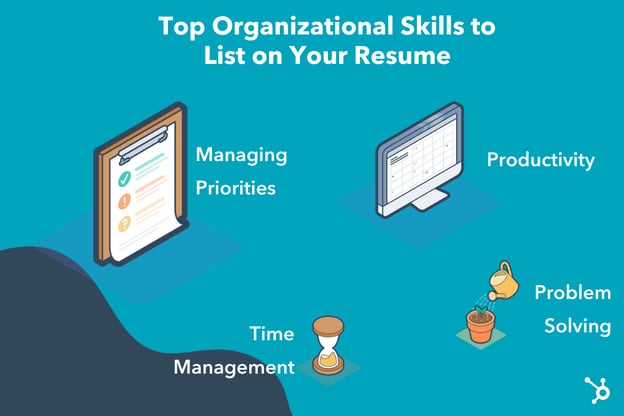
The best way to develop organizational skills is to truly own your calendar. Block off time where you need to get work done. Then, create a schedule for yourself that is realistic to stick to. It's hard to stay organized when you have random meetings popping up on your calendar.
Additionally, it's important to know how you work best. For example, I like to have meetings back-to-back because it's hard for me to get work done in 30-minute increments between meetings. I want all my meetings at the same time, so I can block working time and then meeting time.
When you have a lot on your to-do list, you can make separate lists for what needs to get done and when. I usually have a running to-do list where I'll add everything I need to do for the week. Then, I'll break that down into daily to-do lists. You can organize your lists by tasks, meetings, reminders, etc.
Obviously, everyone works differently. That's why it's important to figure out how you work best. Do you like using a physical calendar or a digital calendar? Regardless, you'll need tools to help you stay organized. Below is a quick list of physical and digital tools to help you get started.
Another way to develop organizational skills is to communicate with your team. It's important to communicate your plan of action to any necessary stakeholders. Additionally, communication will help keep you accountable.
If you're working on a project with several people, you can communicate updates on your part of the project as they occur or at the end of the day. This is a great way to keep the team organized and on task.
Lastly, to truly be organized, your workspace should be free from clutter. While not everyone likes to keep everything neat and tidy all the time, you should still only have necessary items on your desk so you don't get distracted. This will help productivity and organization overall. When you need to find a list or an item, it's important that you know where it is and it doesn't get lost.
Now you might be wondering, "How can I use these organizational skills in the workplace?" and "How can I highlight these skills?"
The first step is to list these skills on your resume when you're applying for jobs. You can say "organizational skills" or you can list other skills, like the ones above, to be even more specific.
If you're in a job interview, think of stories and examples of how you remained organized and how it helped you solve a problem or complete a project successfully. It's important to discuss how you scheduled your time, how you handle multiple assignments, and how you delegate tasks.
While a potential employer might not ask specific questions about organizational skills, you can highlight these stories in questions like "What are your strengths?" and "Why are you a good fit for this role?"
Once you're working for a company, you can highlight your organizational skills during projects or meetings. It's a good idea to use these skills whenever you can because it's sure to impress your boss and help you move forward in your career.
Organizational skills don't just mean that you keep to-do lists. It means you manage your time efficiently, you're productive, can solve problems, and think critically. That's why it's important to develop your organizational skills whenever you can.


You don’t want to waste time simply guessing what a prospect or customer wants and needs from your business or how they’ll react to a certain marketing campaign or strategy that you plan to implement.
Rather, you can turn to the process of data-driven marketing to make informed decisions that are based on real data to ensure your marketing efforts are relevant to prospect and customer interests and behaviors.
Now you might be thinking about the fact that your business has a large volume of complex data that are dispersed across multiple sources — this is where data mapping comes in handy.
![Download Now: 2021 State of RevOps [Free Report]](https://no-cache.hubspot.com/cta/default/53/78dd9e0f-e514-4c88-835a-a8bbff930a4c.png)
Data mapping is a key part of data management and data integration. That’s because it ensures you’re looking at and considering all of your data and doing so accurately — in other words, data mapping is what allows you to integrate your data from multiple sources.
In this blog post, we’ll talk more about what data mapping is, why it’s useful, data mapping techniques, and data mapping tools.
Data mapping is the process of matching data fields or elements from a source, or sources, to their related data fields in another destination — it’s how you establish relationships between data models that are in different sources or systems. Data mapping software and tools automatically match data fields from one data source to another for you.
Data mapping allows you to organize, distill, analyze, and understand vast amounts of data that live in various locations so you can draw conclusions and insights.
Here are some more reasons why data mapping is both useful and necessary:
A business like Amazon may use data mapping to accurately target you. They do this by pulling insights from your browsing habits, reviews, purchase history, and time on page. They can then pull and connect that data to/with data from other sources such as demographic information.
By combining these types of data sources, Amazon has the necessary information to target you with certain products and personalize your shopping experience in a number of ways (e.g. based on challenges you may be facing, geographic location, experience level, interests, education, nationality, age, and more).
Let’s consider another data mapping example — say you work for a TV network and you’re looking to organize TV shows on the network, actors who appear on the network, and actors within a show that appears on the network. The sharing of data between the three sources may look something like this:
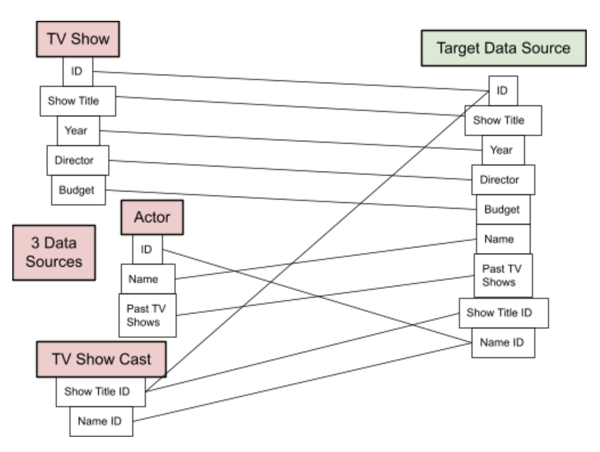
Within data mapping, there are three main techniques that are used — manual mapping, semi-automated mapping, and automated mapping. Let’s talk about what each of these techniques entails.
Manual data mapping requires professional coders and data mappers — IT will code and map your data sources. Although this is a heavy lift and requires professional help, it allows you to fully control and customize your maps.
Semi-automated data mapping (or schema mapping) requires some coding knowledge and means your team will be moving between both manual and automated data mapping processes (hence the name of this technique).
Data mapping software creates a connection between the data sources and then an IT professional reviews those connections and makes manual adjustments as needed.
Automated data mapping means a tool will take care of all aspects of the data mapping process for you, making it an ideal option, if you are not/ don’t have access to a coder. This type of software will typically allow for drag-and-drop mapping. You just need to learn how to use the tool (and pay for it).
Speaking of the tools that will automate the process of data mapping for you, let’s review some of your options next.
Data mapping tools and software make the process of data mapping —including visualizing and interpreting your data — easier. There’s no code needed, they often have a drag-and-drop user interface (UI), and you can implement them on your team no matter your level of technical experience. Many data mapping tools also have the ability to help you with other data management tasks such as data migration.
Price: Free 30-day trial; contact for a quote.
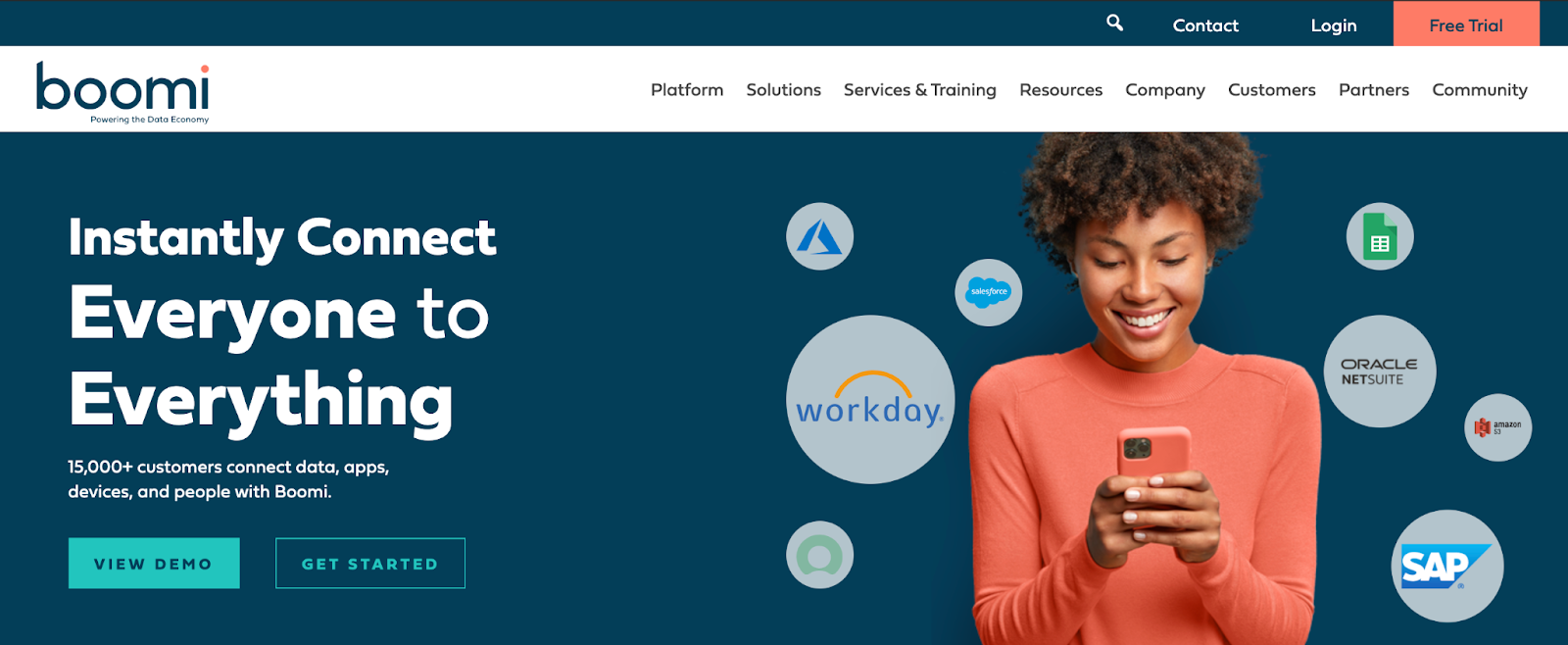
Bloomi, which is owned by Dell, is an iPaaS solution — that’s both cloud-native and scalable — that connects both cloud and on-premise data and applications. Design cloud-based integrations, which the tool refers to as Atoms. Then, you can begin transferring data between the cloud and your on-premise apps.
Bloomi’s data mapping functionality translates electronic data interchange (EDI) for you. The tool has a drag-and-drop UI that makes data mapping easy as well as a library of available connectors so you can establish integrations quickly.
Price: Free 30-day trial; $12-$70/ user/ mo.
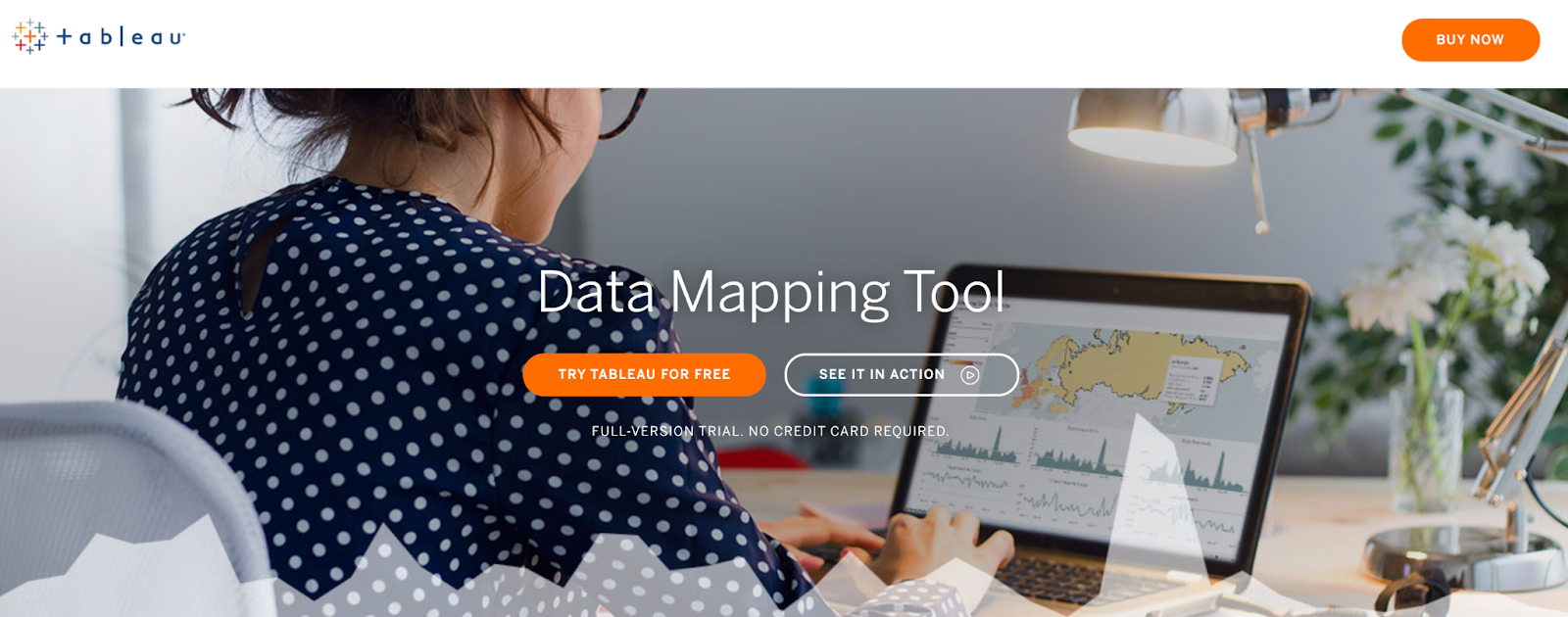
Tableau is a visual analytics and business intelligence platform with data management and data mapping tools. Whether your data is in spreadsheets, Apache Hadoop, databases, the cloud, etc., the platform allows you to connect and begin visualizing your data in seconds without code.
Tableau regularly populates your most recent data (on a schedule that you can adjust). The drag-and-drop interface is easy to use and smart dashboards allow for effective data visualization. Lastly, you can easily share your data maps and dashboards with your team via mobile device for easy alignment and access.
Price: Free 14-day trial; contact for a quote.
Astera is an enterprise data management software that uses visual interfaces to convert, map, and validate data structures for you without the need for code.
You’re able to use the tool’s drag-and-drop feature to create, debug, and manage complex data integration tasks. Astera also natively connects to a variety of database providers including SQL Server, Oracle, and DB2.
To ensure your data is of the highest quality, there’s built-in data cleansing, data profiling, and data quality options — and to improve accuracy, there are built-in transformations that remove duplicate records, complete missing information, and get rid of redundant data. You’ll get flagged and receive emails if and when your data records don’t meet the high-quality data standards.
Data mapping has the power to ensure your marketing team and business as a whole get the most out of your data. It also helps you maintain high-quality data and automate the processes of data integration, transfer, migration, and more. Determine which technique you'll use and if you need a tool to get started with data mapping on your team.