Please visit Search Engine Land for the full article.


from Search Engine Land: News & Info About SEO, PPC, SEM, Search Engines & Search Marketing https://ift.tt/3eN77al
via


As a Boston-based young professional, the biggest product I've had to invest in was an over-priced apartment.
And this year, with apartment tours going fully virtual, I've found it even harder to do the extreme research needed before committing to a lease. Now, as I research apartment after apartment online, my new process feels like an intense buyer's journey.
In my research phase, I spend hours on end scouting listings, looking up addresses on Google Maps, researching neighborhoods, skimming through Yelp reviews of prospective property managers, and analyzing photos or video tours for potential problems that an unseen apartment could have.
Ultimately, I've found that the apartment listings I'm most drawn to have links to video tours filmed by current tenants.
When I've watched tours filmed by tenants, they'll explain what they like about their apartment, note major pros and cons, and give tiny -- but authentic -- details that the average salesperson might not offer. For example, in one video, a tenant honestly revealed one pro and one con about a bathroom by saying, "The bathtub has a great jacuzzi, which makes up for the lower water pressure."
After viewing a pleasant and seemingly trustworthy virtual tour, I feel like I've gotten an in-depth and authentic look at the product, as well as thoughts from a previous customer who is an expert on the product. Additionally, because the tenant often voluntarily offers their time to host the create video or virtual tour, I also get the sense that they are willing to help a trusted landlord find a new tenant.
Ultimately, I'm more likely to respond to an apartment listing with a great tenant-generated virtual tour than a listing with over-produced images or videos edited by an outsider.
When it comes to smaller purchases, I feel the same way about promotional content created by customers. This content shows me what the product is like in real life and proves that customers are delighted enough about their experience to promote a trusted brand.
And, I'm not the only consumer (or marketer) who thinks this. An estimated 90% of consumers say user-generated content (UGC) holds more influence over their buying decisions than promotional emails and even search engine results.
Below, I'll highlight more stats, facts, and figures that demonstrate the benefits of user-generated content.
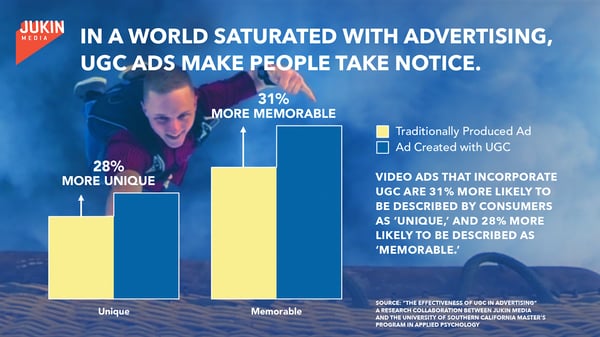
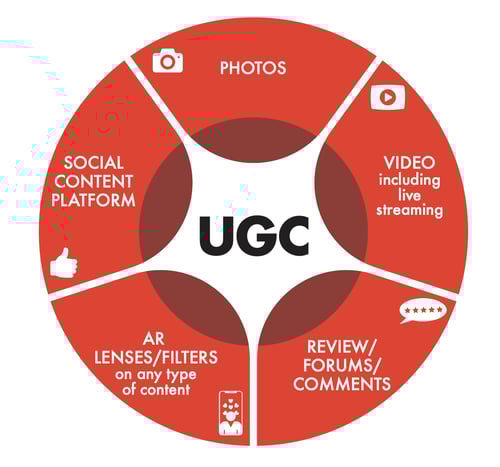
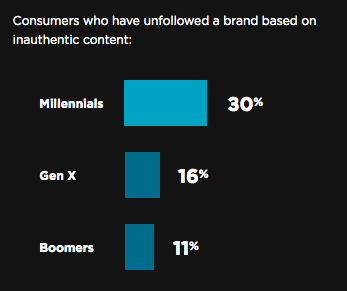
As you can see from the stats above, user-generated content not only saves you production time, but it can also make your brand more authentic and trusted.
If the data above has persuaded you to implement UGC in your marketing strategy, here are a few next steps you can consider:
To learn more about how to leverage user-generated content in your marketing, click here.

Social media is an undeniably powerful channel for marketing in 2020.
In fact, social networks are the biggest source of inspiration for consumer purchases, with 37% of consumers finding purchase inspiration through social channels.
However, if you're using social media as a tool for organic exposure and brand awareness, rather than just a channel for paid ads, it can be difficult to track the success of your efforts.
As any social media manager knows, successful implementation of a social media strategy is contingent on countless factors — and all companies prioritize different channels, metrics, and criteria for success.
For example, is paid more important than organic to your business, and if so, to what extent?
Is more importance placed on audience engagement, or audience growth?
Has a posting cadence been directly tied to revenue?
With so many areas of focus for social media marketers, it's crucial to choose, analyze, and report on your key social media metrics with a social media report.
A social media report can help you clearly convey what factors your social media team prioritizes, why those factors matter, and how you're performing against those goals.
In this post, we'll highlight the importance of a social media report, list the metrics you should consider including in one, and walk through a step-by-step process for building a social media report yourself.
For a quick and easy solution to your reporting woes, click here to download HubSpot's Free Social Media Reporting Template.
A social media report is the best way to distill the key metrics your social media team is tracking on a daily, weekly, monthly, quarterly, and/or annual basis.
Since social media encompasses so much, gathering and reporting on the data and channels that you've determined are most important for your business provides a lens of focus for your social media marketing team, and delivers a necessary high-level overview for leadership.
Social media doesn't just affect marketing. Prospects ask questions, customers write reviews, and thought leaders follow you for company news. Because social media coincides with nearly every aspect of your organization, gathering and distributing the state of your social media channels is a move that shows transparency and encourages cross-company alignment.
You can also use a social media report to report on campaign-level analytics. If your social media account is serving as a cog in a larger company initiative, this report shows to what extent social media contributed to the project's success.
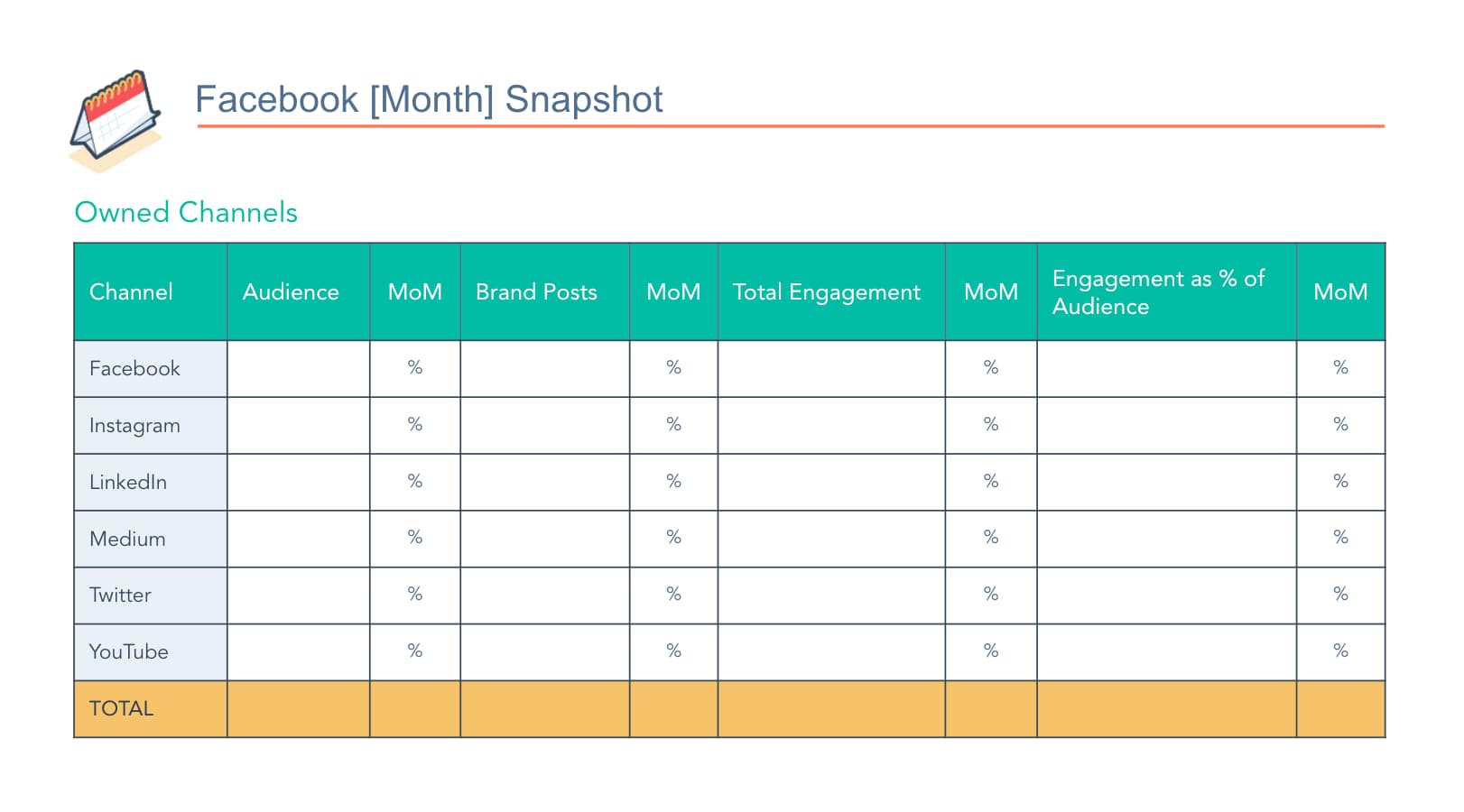
HubSpot's free social media report template has pre-made slides for you to report on all of your predominant social media metrics. Download the template today and simply plug in your own metrics to customize a social media report for your organization.
Your business likely values some metrics over others when it comes to social media reporting. Likely, these metrics also vary between your channels — since LinkedIn doesn't let you retweet, and Twitter doesn't let you click a cry-face button.
Before you start reporting on your social media channels' performance, read through this list of options of social media metrics so you can determine which ones you should include in your report.
This metric tells you how large your reach is and how quickly that reach is growing. This is typically seen as the core social media metric, as it shows how large of an audience you can leverage with your posts and content.
A rather self-explanatory example, this metric represents how many times you posted in a given time period. This metric is usually compared alongside other metrics — such as engagement rates — to help you determine the right cadence for your audience.
This metric should also be channel-specific, because it makes sense to post more frequently on some channels than others.
Post engagement measures how your fans and followers are reacting to your posts with likes, comments, and shares. A healthy post engagement suggests you have a loyal audience — and that your content is reaching them.
You can also track engagement as a percentage of your audience to determine engagement rate.
One metric you have a little less control over is mentions. You can track mentions from customers, prospects, and even news outlets to gauge perception of your business and brand online.
When a post links to a page on your website, you can measure how many people and what percentage of your audience clicked through to the page. A strong clickthrough rate shows you're sharing website pages that your audience finds relevant.
Conversions comes into play if you're using social media to generate leads, subscribers, or even customers. If you want to attribute contacts to your social media team's efforts, make sure you're using proper tracking and setting reasonable goals, as it's rare in some industries to go straight from social media to becoming a customer.
Directly tracing ROI (return-on-investment) to social media efforts can be tricky. However, if you determine it's worth reporting on this metric, make sure you have proper expectations set and attribution models established.
This metric is essential for monitoring the performance on your social media ads. If you're solely reporting on organic social metrics, you can ignore this one.
To provide a benchmark, consider analyzing the aforementioned metrics for your competitors. Obviously, these metrics can vary drastically based on publicity, paid budget, and the size of the company, but it's still worthwhile to make the comparison.
For consistency and clarity, make sure you're using a social media report presentation, spreadsheet, or memo template. This way, each time you update your metrics, you'll simply need to copy over your most up-to-date metrics onto that template rather than reinventing the wheel every time.
We suggest using a PowerPoint or Google Slide Deck template, because you can share it with your team via email, use it for an in-person meeting or presentation, or both.
Need a template to get started? Try this one.
Like we've established, different companies and different social media teams value different social media metrics.
It's your job to choose the metrics that matter most to your team and your organization.
Using the list from the section above, narrow down the essential metrics you believe are worth presenting to your team at large. Remember, you can change which metrics you report on for each of your organization's social media platforms.
If your social media report is campaign-specific, reach out to the project stakeholders to see if they're hoping to see reporting on any certain metrics in the social media report.
Pro Tip: For your first few ongoing social media reporting presentations, ask your peers which metrics they'd like to see, or which ones they need clarification on. Making these changes sooner rather than later helps you keep your team informed and engaged.
Once you know what you're reporting on and how you're reporting it, it's time to start collecting data.
When you're first setting up your social media reports, create bookmarks for your data sources. Make a folder for the analytics page for each social media channel you're analyzing and/or your social media reporting software for an all-encompassing view.
If you're tracking click-throughs to your website, make sure you're analyzing from a single master location, such as your tracking URL builder or your traffic tracking tool like HubSpot or Google Analytics.
A chart of numbers on a slide deck is, well, pretty boring.
While a numerical chart is important for sharing as much info as possible in an organized way, using visuals is a better way to convey the growth and success metrics of your social media performance. Try incorporating one or all of the following into your social media reports:
These examples are more eye-catching than numbers on a slide and further illustrate what you want your team to walk away with. If data visualization is new to you, check out our Guide on Data Visualization for Marketers.
A running social media report should always remind people about where you came from and where you plan on going. That said, make sure your reports make reference to how your numbers have changed since the last period of time on which you presented, in addition to why numbers have changed.
Did follower growth as a percent increase drop last month? Maybe that's because one of your posts from the month before went viral and resulted in unprecedented growth that was impossible to match. Make that clear and add context to the numbers.
Additionally, each report should contain clear action items about how you plan to continuously improve your social media performance. Social media is constantly evolving, so your approach and strategy for it should, too.
Now that you're equipped with the knowledge to build, design, and share your social media report, download your social media report template and get to work!

When content marketing was gaining steam, there were really only a few techniques you could leverage.
On a typical day, you'd write a blog post, hope it ranked on Google, send it to your email subscribers, and post it to your social media profiles.
That was pretty much it.
This is still the main strategy most marketers use nowadays, but since content marketing has exploded in popularity since its early adoption, it has developed into a much more nuanced and complex type of marketing with many techniques for reaching and resonating with an audience.
To help you learn about the most effective marketing techniques around today, we've rounded up the best ones to add to your content marketing arsenal.
Every company has a different set of customers, so there's no one-size-fits-all formula for designing the most optimal CTAs. To figure out which CTA copy will produce the best results for your company, you must discover what your unique set of customers prefer.
With A/B testing, you can run an experiment between two variables, like a red and blue CTA, and identify which one produces better results. A/B testing shouldn't be confused with multivariate testing, though, which allows you to simultaneously test many variables.
To conduct an A/B test, you can use HubSpot's A/B testing kit. With this kit, you'll get guidelines for A/B testing, learn what variables to test, and gain access to a simple significance calculator to track your results.
Did you know that more than 50 percent of U.S. respondents check their personal email account more than 10 times a day, and it is by far their preferred way to receive updates from brands.
This means that there isn't a lot of room for error when you send an email. To avoid any issues, a great marketing technique to implement is to begin previewing your email in different email providers before sending.
There are plenty of tools you can use to preview your emails such as HubSpot's free email software. With an email preview tool, you can test your emails before you send them and see how they look in every service provider.
When you write a blog post, do you use the first title you came up with or do you write a few?
Most marketers write several headlines before deciding which one to use. However, it's not always easy to decide.
To make this decision, you can run an A/B test and see which types of titles work best for your audience.
Additionally, you can use tools like this headline analyzer to see what you can do to improve your headline.
In the neuroscience field, researchers have proven that storytelling is the best way to capture people's attention, bake information into their memories, and resonate emotionally with them. The human brain is programmed to crave, seek out, and respond to well-crafted narrative -- that'll never change.
So just like your favorite Netflix show, you can craft a series on YouTube to entice your viewers subscribe to your updates. This can get your audience more excited for your show's newest season than they currently are for the latest season of Stranger Things.
Before you green light another slew of listicles, how-to posts, and ultimate guides, remember how powerful storytelling is and consider crafting a YouTube series, podcast, or social media hashtag chock-full of conflict, surprise, and emotion that your viewers will relate to your brand.
Since people heavily rely on Google to provide accurate and relevant answers for most of their questions today, Google needs to understand the intent and context behind every single search.
To do this, Google has evolved to recognize topical connections across users' queries, look back at similar queries that users have searched for in the past, and surface the content that best answers them. As a result, Google will deliver content that they deem the most authoritative on the topic.
To help Google recognize your content as a trusted authority on marketing, sales, and customer service topics, consider implementing the pillar-cluster model on your blog.
Essentially, the pillar-cluster model is a topic-based based content strategy. This means that you generate and organize ideas for your blog by topic.
By creating a single pillar page (an ultimate guide, for instance) that provides a high-level overview of a topic and hyperlinks to cluster pages (subtopic blog posts) that delve into the topic's subtopics, you can signal to Google that your pillar page is an authority on the topic.
Hyperlinking all of the cluster pages to the pillar page also spreads domain authority across the cluster, so your cluster pages get an organic boost if your pillar page ranks higher, and your cluster pages can even help your pillar page rank higher if they start ranking for the specific keywords they're targeting.
As of now, subscribing to your favorite online publications through email is the best way to keep up with their latest stories and news. And since it takes an average of six to eight touch points to generate a qualified sales lead, persuading people to subscribe to your emails and, in turn, constantly consume your content will generate more leads and revenue for your business.
Growing an engaged, loyal subscriber base also speaks volumes about the quality of your content and its emotional resonance. Even though hoards of content saturate the internet and most people's inboxes today, people are still actively engaging with your content, which is a clear sign that they actually value it.
To build your email list, you'll want to use an email marketing software like HubSpot. This way you can create, personalize, and optimize marketing emails without needing a developer.
In 2015, HubSpot made a revolutionary discovery about our organic monthly blog traffic -- the overwhelming majority of it came from posts published prior to that month. In fact, 76% of monthly blog views came from these old posts.
Today, the groundbreaking revelation rings louder than ever -- 89% of our monthly blog views currently come from posts that were published at least six months prior, and we've developed an entire strategy dedicated to refreshing and republishing these historical pieces of content.
These types of blog posts are called "updates", and they comprise 35-40% of HubSpot's editorial calendar. By refreshing posts with new information and effectively republishing them as new blog posts, HubSpot can build upon its existing organic value that these posts have accumulated through backlinks and user engagement and double or even triple their traffic. This process also helps HubSpot optimize our blog for efficiency, decreasing the amount of new content we have to create while increasing our organic traffic and conversions.
According to a content format study conducted by Edison Research and Triton Digital, people age 12 and older are listening to online audio content at unprecedented levels. On average, people spend 17 hours per week tuning into their favorite podcasts, online radio shows, and audiobooks. There are also 14 million more weekly podcast listeners this year compared to last year, which is more than Guinea's entire population.
The demand for audio content has exploded, but that doesn't mean people will listen to your branded podcast just because it's a podcast. In reality, they'll only listen to it if it can hold their attention and, ultimately, entertain them. Otherwise, producing yet another interview-an-expert podcast like everyone else will only add to the noise flooding the internet.
Earning high-quality inbound links from websites and pages with high authority scores is crucial for boosting your domain authority. But, unfortunately, "If you write it, they will link to it," is not a viable SEO tactic.
An effective method for earning high-quality links is by asking other websites that have the same or higher domain or page authority score than you to link to your top content. You should also make sure your content is relevant to the referring website's content.
Another way you can earn quality backlinks is by using Backlinko's skyscraper method. The skyscraper method is an SEO strategy where you find content that ranks well for keywords you want to rank for and then create content that's better than the top ranking posts. Then, you use SEO tools to find all the sites that have linked to your competitor's content and ask the most relevant sites to replace your competitor's link with a link to your improved content.
Today, over 30% of time spent online is dedicated to social media. Needless to say, people spend more time on social media than ever before. And public relations professionals are pivoting their strategy from solely focusing on placing their stories in news outlets' publications to concentrating on driving traffic to their social media profiles too.
In order to successfully pitch your stories to journalists and news outlets nowadays, you need to account for the content that performs well on their social media profiles and their publication. So before you pitch your story, make sure it's relevant and interesting to the news outlet's social audience.
In a world overflowing with digital noise, creating irrelevant or unwarranted content won't catch anyone's attention.
To create personalized marketing campaigns for each slice of your target market, consider leveraging audience segmentation, which separates your target market into specific, accessible groups of people based on personal attributes like their demographics, psychographics, and behavioral information.
To properly implement an audience segmentation strategy, you can use a marketing software like HubSpot. For example, with HubSpot's marketing software, there's a lead collection and tracking feature where you can segment and nurture your leads. This makes it easy to build an email list, automate campaigns, and expand your database.
Big companies often extend their brand to develop new products in industries that they don't have any market share in. These initiatives are called brand extensions, and they allow companies to leverage their brand awareness and equity to create more revenue streams.
Historically, the most successful brand extensions are the ones that closely tie to the company's flagship product or core brand, like Gerber's baby clothes and Dole's frozen fruit bars. So by entering tangential markets that can preserve your brand's unique associations and perceived quality, you can develop new products that consumers intuitively understand the benefits of, even though they've never seen them on a shelf.
On the flip side, a company can also exploit its brand, and, in turn, damage it. If they develop a product in a market that isn't closely tied to their flagship product or core brand, audiences might attach undesirable associations to a brand, weaken its existing associations, and hurt its established products' perceived quality.
When you're developing a new marketing plan, it's important to consider new marketing techniques. Don't forget to continuously innovate on your strategies.
Editor's note: This post was originally published in May 2019 and has been updated for comprehensiveness.


